Saturday, May 2, 2026

The Map To The Goldmine 2.0

I've found myself compelled to write after a gap of almost four years, and surprisingly this time it isn't an obituary. Since the blog settled into its state of suspended animation some eight years ago, my writing assignments have mostly focused one eulogizing some of the greatest talents produced by Pakistan. But back in the more wild-west days of the blog, when it hadn't been wholly taken over by my overlong monographs on Qawwali, this blog was your go-to guide to committing musical piracy. 

Some seventeen odd years ago, I discovered the then new-fangled streaming service Spotify, and was immediately blown away by the wealth of music available there. Since Spotify was then unavailable in Pakistan, I posted a guide to accessing the then nascent streaming service by methods which could charitably be described as less than legal. In my naivety, I had announced back in 2009 that Spotify held "almost the COMPLETE EMI PAKISTAN CATALOGUE !!!!", in all-caps and with four exclamation marks. Little did I know that the Pakistani music available on Spotify and other streaming sites was but a fraction of the catalogues of music recorded by EMI Pakistan and other Pakistani music companies. What I was to discover later was that in addition to the music released in by record companies, there exists a massive treasure trove of unreleased music stored in the archives of Radio Pakistan, Pakistan Television, the Pakistan National Council of the Arts and other national cultural organizations. 

Radio Pakistan especially, has remained the repository of Pakistan's sonic heritage for the last eight decades, broadcasting music from all parts (and before 1971, both wings) of Pakistan. Through its Transcription Service - later christened the "Central Productions Unit", Radio Pakistan also preserved recordings of a significant proportion of its broadcasts on tape and occasionally released selections from its archives in collaboration with EMI Pakistan. The vast majority of the Radio Pakistan archives however, remained stored in its vaults, often in very precarious conditions. A few years ago, thanks to the efforts of an enterprising producer, Radio Pakistan launched a YouTube channel where they began uploading some of the music from their archives, and we were treated to such gems as Aniqa Bano singing a Mus'hafi ghazal to the tune of a Pahari folk song and Ali Bakhsh Zahoor singing an actual folk song my grandmother used to sing to me. In addition, scattered recordings from the Radio Pakistan vaults could be found in the archives of collectors like Irfan Gabol, or the legendary collection of Luthfullah Khan Sb, curated on Khursheed Abdullah Sb's YouTube channel

Sometime last year, on one of my frequent trawls on the internet, I cam across something extraordinary, a new set of recordings by one of my favorite Qawwals. After overcoming my surprise (and joy), I did a fair bit of digging on a number of streaming sites and found out something that I'd like to announce today; besting my previous record, this time in all-caps, bold, and followed by five exclamation marks. Here goes: RADIO PAKISTAN HAS BEGUN RELEASING ITS CATALOGUE ONLINE !!!!! 

In the last six months, over a thousand albums, EPs and singles have been released on streaming by Radio Pakistan. Per usual, this has been done with very little fanfare, in an extremely arbitrary and haphazard manner, and with multiple labeling errors. The Hafiz Atta Muhammad Qawwal release features Ustad Naseeruddin Saami on the cover, the Fateh Ali-Mubarak Ali albums can be found under the image and name of the classical vocalist Ustad Mubarak Ali, the Hamid Ali Bela albums feature the Patiyala Gharana vocalist Hamid Ali Khan, while the Salamat Ali Khan releases comprise a hodgepodge of tracks from Ustad Salamat Ali Khan of the Sham Chaurasi Gharana, Ustad Salamat Ali Khan the flautist and Ustad Salamat Ali Khan the ghazal singer. Be that as it may, the fact that gems from the Radio Pakistan archives, most of them unheard since their original broadcasts, are being released digitally in high quality audio recordings, is, to reiterate, a "Really Good Thing". Credit is due to the Radio Pakistan administrators and the powers that be, and I hope this project continues till most, if not all of the Radio Pakistan archives are available to the public again, thus fulfilling an important part of it's mandate as Pakistan's public broadcaster. Now if only someone would do the same with the issues of the Radio Pakistan magazine 'Ahang', we'd have access to a wealth of images and printed material charting the histroy of Pakistan from it's inception till today.

A veritable feast of Pakistani music is now available online, and it's staggering diversity reveals that in it's heyday, Radio Pakistan was exposing the Pakistani listening public to wonderful music from the length and breadth of the land. Now, for your listening pleasure are available recordings from erstwhile East Pakistan, Punjab, Sindh, Balochistan and Khyber Pakhtunkhwa , featuring ghazals, geets, kaafis, qawwalis, hamd and na'at, with reliable sources informing me that releases from the Classical music archive are soon to follow. Since most streaming sites don't allow you to search for music by record label, my go to search tools have been the brilliant (if buggy) lbl.fm and the search page of Qobuz.com. Most of the recordings have been released under the generic title "Radio Pakistan Hits" and can be found on YouTube Music as well as Spotify. There's a mindbogglingly vast catalogue to explore, and if you're like me, hours upon hours of happy listening. To whet your appetite, I'll end the post with five of my current heavy-rotation favorites from the Radio Pakistan archives, tracks that left me slack-jawed in admiration and became immediate all-time favorites.

1. Ze Bedaade Tau Harf e Mehr Ra Naam o Nishaan Gum Shud - Ustad Fateh Ali Mubarak Ali Khan

 When I first stumbled on this erroneously labeled album, I let out a yelp of excitement that startled half my neighborhood. This Nazeeri Nishapuri ghazal is one of the most beautiful Qawwalis I've ever heard, and that's saying something.


 2. Kuja Boodi Ke Imshab Sokhti Azurda Jaanay Ra - Ijaz Hussain Hazravi

Another Nazeeri Nishapuri ghazal, this time by the ghazal singer who was one of Munshi Raziuddin's favorite musicians, and after listening to this recording, one can see why. Hazravi Sb was the pre-eminent young ghazal singer in Pakistan before Mehdi Hassan's ascendancy, and remained a deeply soulful voice till the end of his career.


3. Mere Dil Ko Shauq e Fughaan Nahi - Rasheeda Begum

One of the many "Radio Singers" I discovered via these recent releases, Rasheeda Begum's voice is a mix of Suman Kalyanpur and Mubarak Begum with a sweetness of tone and purity of talaffuz that made me an instant fan. Here she sings a ghazal of the 18th-19th century poet Khwaja Haider Ali Atish.


4. Jind'ri Lutti Tain Yaar Sajan - Basheer Ali Mahi

Basheer Ali Mahi was already one of my favorite singers. Listening to the half-a-dozen new recordings of his has deepened my admiration for him immensely. Here he sings the quintessential kafi known in my neck of the woods as the 'Rohi', imbuing it with his beautiful murki's and zamzamas. If that wasn't enough, he adds an extra verse at the end that I've never heard anyone else sing.


5. Kabeera Bhala Hua - Manzoor Ahmed Niazi Qawwal Aur Hamnava (The Badi Party)

There is something almost unbelievably brilliant about the fact that this 37 minute magnum opus of classical, khanqahi Qawwali was actually broadcast on Radio Pakistan. I can gleefully imagine an impressionable listener somewhere, tuned in to radio, completely oblivious to the fact that they were about to get their head blown open and their mind expanded to the n'th degree by the Badi Party in it's prime, firing on all cylinders, performing to an appreciative and animated audience.


There have been 1233 (!!!) singles, EPs and albums released so far on the PBC Music label, with a couple of dozen new releases every week. There have also been rumblings of a similar release program for the Pakistan Television musical treasures, which, if true, would mean another series of sleepless nights while I gorge myself on further musical delicacies. 


All in all, not a bad time to be a fan of Pakistani music.

Saturday, August 27, 2022

...On Nayyara Noor's Passing

Nayyara Noor’s name translated into ‘a radiant star of light’. On 20th August, the star of her life on earth was extinguished after a battle with cancer. As with Shaukat Ali last year, Nayyara Noor’s death is something of a personal tragedy for me, because of the inextricable link between her voice and my formative years. Her voice was my initiation into the world of ghazal and nazm, my introduction to the poetry of Faiz, Nasir Kazmi and many others, my key to exploring music from my grandparents and great-grandparents generation, and an early introduction to the work of the golden generation of Pakistani TV composers. Through my personal recollections of some of her cassette albums, as well as around half a dozen of my favorite songs of hers, I’ll attempt to paint a picture of why Nayyara Noor remains such an indelible part of my life.

Nayyara Noor, one of five children, was born in Guwahati, Assam in 1950 to a family originally from Amritsar. While she migrated with most of her family to Karachi when she was seven years old; her father stayed on for another 35 years. The second decade of her life was spent in Karachi and later Lahore, where she was discovered while singing in a musical evening in the National College of Arts. Prof Asrar Ahmed of Islamia College Lahore was the first to encourage her to sing, composing several pieces for her in her initial years as a singer. In the early 1970s, Shoaib Hashmi, along with his wife Saleema, Farooq Qaiser, Shahid Ttosy and Arshad Mehmood created a number of highly influential sketch shows for PTV, including Such Gup and Tal Matol. Every week, the sketches would be interspersed with one or two songs by young Nayyara, sitting as if lost in a reverie, singing to herself, oblivious to the camera’s attention. Her singing style was completely different from the reigning queens of Pakistani music, including Iqbal Bano, Farida Khanum and Noorjehan. Completely devoid pf the ‘nakhray’ and the ‘nritya’ of her contemporaries, she sang in a simple, almost matter-of-fact way, letting the sweetness and beauty of her voice shine through.


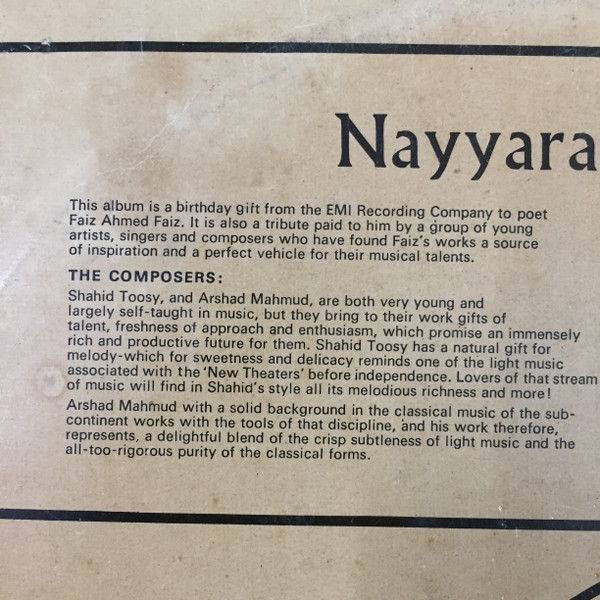
In 1976, in celebration of Faiz Ahmed Faiz’s 65th birthday, Shoaib Hashmi, along with his Tal Matol team collaborated with EMI Pakistan to release a seminal album, “Nayyara Sings Faiz”. From its first track, ‘Intesaab’ (Preamble) to the concluding piece ‘Khair Ho Teri Leylaon Ki’, each track presented a fresh, distinct interpretation of Faiz. The album liner notes highlight the youth and freshness of the contributors, as well as Faiz’s personal involvement with the project. Nayyara herself considered this project, and her association with Faiz as one of the fondest and most affecting memories of her life. This album, initially released as an LP and later on cassette and CD, was the gateway to Faiz, and to the beauty of Urdu poetry, for me and many listeners of the preceding generation. The sweetness and malleability of her voice was perfectly suited to Faiz’s nazms and geets, as a result, tracks from the album are now considered some of the finest interpretations of Faiz ever recorded. In probably her finest achievement as a singer, as with Noorjehan and ‘Mujh Se Pehli Si Mohabbat’, Mehdi Hassan with ‘Gulon Main Rang Bharay’, and Iqbal Bano with ‘Dasht-e-Tanhai’, Nayyara Noor was able to make a Faiz nazm synonymous with her name, ‘Aaj Bazar Main’. The “Nayyara Sings Faiz” cassette tape was in such heavy rotation in my home growing up that it had to be replaced at least three or four times because of wear and tear.


Another one of Nayyara Noor’s cassettes proved an important gateway for me. Ever since I could remember, I had been obsessed with music from the golden era of Hindi films, yet was totally unaware of the wealth of music released before partition. Nayyara and her husband had released a cassette of covers of 1930’s and ‘40s film songs titled ‘Yaadon Ke Saaye’ in 1988, and I happened upon it in my parents’ cassette collection in almost 10 years later, when I was eleven. Violinist Javed Iqbal’s wonderful arrangements and Nayyara’s wonderful singing ensured that these 50-year-old melodies sounded fresh to my ears, and propelled me towards discovering the wonderful music of the pre-partition era, which enamors me to this day. The story goes that when the great Anil Biswas heard Nayyara’s rendition of one of his 194s hits, he exclaimed “I wish she had been around when I composed the song in the forties. I would have happily used her as a playback singer.” He autographed the cassette flap of the album for her, an autograph which she considered her most prized possession and which she framed and displayed in her house.


One of the mainstays of the Pakistani music industry has been the TV drama series OST. In the heyday of the Pakistan Television, from the ‘70s to the ‘90s, PTV collaborated with EMI Pakistan to release a series of albums titled TV Hits, featuring OSTs as well as hit songs from PTV’s musical programs. Featuring compositions by some of Pakistan’s leading composers, including Khalil Ahmed, Mian Sheheryar and Arshad Mehmud, Nayyara Noor’s prolific PTV output yielded not one but two highly acclaimed ‘TV Hits’ albums, featuring some of her greatest hits. Even these albums didn’t do full justice to her work on PTV. Her haunting, melancholy-tinged ‘Kabhi Hum Khoobsurat Thay’ from Shehzad Khalil and Rahat Kazmi’s 1980 play ‘Teesra Kinara’ (an adaptation of Ayn Rand’s Fountainhead) is one of her most enduring hits. The crowning glory of 1980’s Pakistani Drama, ‘Dhoop Kinarey’ also featured Nayyara Noor singing the title track, an astonishing Arshad Mehmud composition with lyrics by Hasan Akbar Kamal.

 I’ve listened to these albums on repeat since Nayyara Noor’s passing, as well as dozens of other songs by her. I’ve once again been struck by the effortless ease of her singing, the ability to navigate ghazals, geets and nazms without sounding too old-fashioned or too outre’, and the two qualities of her voice immortalized in Jonathan Swift’s wonderful phrase ‘sweetness and light’. The radiat starlight epitomized in her name and her voice may have been snuffed out by fate last week, But there are primeval stars on the edges of creation that dimmed and died eons ago, yet their light still shines across the billions of light-years, and stargazers on earth shall continue to look up into the skies and find comfort in seeing their familiar glowing forms in the night sky. Nayyara’s voice, pouring sweetness and light in our ears for the past fifty years, shall lose none of its radiance as long as there are listeners eager to find comfort, solace and light in music.

Sunday, January 16, 2022

...Of Sacred Soundtracks - Part II

In my snootier days, I was an even more of insufferable snob about pop culture than I am now, disdainfully looking down upon things that I considered too lowbrow. True story, during family road-trips in my early teens, I used to pester the folks to play the cassette of Faiz ghazals in the car stereo and scoffed my younger brother who preferred to bop to the latest Nusrat tape (look how the tables have turned). My disdain for the use of Filmi tunes in Na’at and Qawwali lasted for a long while too, till thankfully I saw the light and mended my ways. As an aside, who wouldn’t after hearing Rasheed Ahmad Fareedi and Co take the tune from one of Noor Jehan’s most popular Punjabi film songs and turn it into a haal-inducing na'at in Raag Darbari. As one of the most ‘awaami’ forms of music, it would be considered natural for Qawwali to borrow freely from film music, probably the most awaami music of the subcontinent. Seven years ago, I wrote about some of my favorite examples of filmi tunes appropriated by qawwals, a post that requires updating to include the many examples I’ve heard and fallen in love with since, including some truly unique ones from artists I had not even heard of back then (case in point).

There is yet another very interesting intersection of filmi music with Qawwali, a phenomenon rarer than borrowing merely the tunes of film songs. Occasionally, film songs are appropriated en-bloc as Qawwali, music, lyrics and all. The rarity of this appropriation can be explained by the fact that for a film song to be performed in a Qawwali setting, the lyrics have to fit the requirements of a Qawwali piece. Love, longing and sorrow need to be couched in language that can suggest more spiritual meanings, rather than temporal superficiality. The essential themes of devotional music; submission, surrender, the expectation of spiritual salvation through love, need to be prominent in the lyrics. That doesn’t seem too big an ask from the music of the golden era of subcontinental film songs, when master lyricists with grounding in Urdu poetics were writing one beautifully written song after another. But the fact remains that very few songs translate well as Qawwalis, probably because the ‘kaifiyat’ a Qawwal aims to induce in the listeners might get diluted by the recognizability and temporal associations of popular film songs. This analysis is best left to ethnomusicologists, who might also find it interesting that most of the film songs appropriated as Qawwalis have been sung by female singers. The majority of Punjabi, Seraiki, Purbi and Brijbhasha devotional poetry, albeit written by male poets, is in the female voice, and these songs are no exception. Below, I present a few of my favorite examples of this subgenre of Qawwali, film songs with spiritual undertones performed as Qawwali. 

1. Ranjhan Yaar – Lyrics: Hazin Qadri, Music: Bakhshi Wazir
Film: Mera Naa Patay Khan - 1975
Film version: Mehnaz Begum
Qawwali version: Ameer Ali Khan Murkianwale Qawwal

    Mehnaz Begum sings this lovely Punjabi song in the Babra Sharif / Munawwar Zareef starring comedy/romance. The composition is lovely, especially the melodic surprise on the second verse of each ‘antra’, and Mehnaz sings it beautifully. While the picturization is a bit comedic (considering Pakistan’s premier film comic of the time, Munawwar Zareef is the object of affections), the lyrics are anything but lighthearted. The words could be interposed to any number of Punjabi Qawwalis written in the mid-twentieth century by Allah Ditta Khaki, Fani Bulandshahri or Purnam Allahabadi. The themes of submission to the Beloved, of being dyed in His hue, of considering him a guide on the true path and the protector of one’s honor, are universally found in Punjabi devotional poetry. It goes without saying that in the hands of a gifted Qawwal, these themes could be elaborated further. In recent memory, there were few Qawwals as gifted as the late Ameer Ali Khan Murkianwale. His style was melodious, playful yet with a rich vein of melancholy, and his deep grounding in classical music was honed by long apprenticeships with his father Rafiq Hussain Qawwal, as well as Nusrat Fateh Ali Khan. This piece occupied a prime place in his repertoire, and he did full justice to it. The video below, from his Dream Journey recording made in December 2016, needs no elaborate write-ups and expositions; the late Ustad’s performance speaks for itself.


2. Jo Main Jaanti Bichrat Hain Saiyyan – Lyrics: Shakeel Badayuni, Music: Naushad
Film: Shabab - 1958
Film version: Lata Mangeshkar
Qawwali Version: Farid Ayaz, Abu Muhammad Qawwal
    
    I would have begun this song’s description by saying that Nutan never looked lovelier, but I realized that such a statement would be incorrect, as Nutan looked lovely in every film she ever did. This beautiful Naushad composition in Maand is based on a Purbi folk-song attributed to Ameer Khusrau (RA) among others. The poignant lyrics by Shakeel feature the theme of separation from the Beloved, prevalent in devotional poetry, especially in Purbi and Seraiki poetry. It doesn’t hurt the poignant power of the song that it is sung by Lata near the peak of her powers. Interestingly, another song from this film has received the Qawwali treatment, a testament to the multifacetedness of Shakeel’s wonderful lyrics. Farid Ayaz, Abu Muhammad Qawwal give this song the Qawwali treatment in another Dream Journey recording from 2018. The raagdaari of the party, including the younger crop of Qawwal Bacche, highlights the beautiful Raag this composition is based on. Abu Muhammad takes the lead in this performance, as one by one the youngsters take flights of taankari. The pathos is tinged with earthiness and a sly, almost playful resignation, befitting the song’s origins in folk music. Farid Ayaz and Co will feature again in this post, for good reason. 


3. Kya Jaane Kya Armaan Le Kar – Lyrics: Qateel Shifai, Music; Rasheed Attre
Film: Anaarkali - 1958
Film Version: Noorjehan
Qawwali Version: Captain Sufi Muhammad Ramzan 
    
    Anaarkali, the Pakistani film version of Syed Imtiaz Ali Taj’s seminal Urdu play, is one of the crown jewels of Pakistani film music. Rasheed Attre and Noorjehan was always a potent combination, but in this film the pair outdid themselves. Basing his compositions on Classical Raags, featuring traditional instruments like the Veena, the Pakhawaj and the Surbahar, Rasheed Attre created more than half a dozen immortal compositions, and Noorjehan did the rest in ensuring their immortality. This song gets extra brownie points for featuring a Veena among the instruments picturized, and being played by someone who’s not simply miming but actually knows how. Noorjehan looks beautiful as Anaarkali, Himalayawala is regal Akbar(albeit a bit worse for wear), and the sets are lavish by Pakistani film standards. The song itself needs no praises, a beautiful composition with lovely lyrics, it is is one of my favorite Noorjehan songs. The Qawwali version of this song is what originally spurred me towards writing this post a while ago. It is incomplete unfortunately, but other than that it’s probably my favorite type of Qawwali performance. An elderly, spectacled gent sits on the harmonium, he sings the asthayi while someone searches for the kalam written in the beyaaz. The beyaaz is placed on the harmonium as the spectacles are placed to one side, and the performance continues. It’s just two people performing, the singer on the harmonium, and a rather talented gent on the tabla, a two-person setup replicated across hundreds of shrines across the subcontinent. It is night, the crickets are chirping, the door to the dargah reveals the mehraabs without. There is no need of taans and raagdari here, no teams of humnavaas, the Qawwal is an obscure musician who does not test his vocal limits, yet the ‘kaifiyat’ of the kalaam is conveyed loud and clear. What more could you ask for?


4. Ve Laggiyan Di Lajj Rakha Layeen – Lyrics: Manzoor Jhalla, Music: Rehman Verma
Film: Chor Nalay Chattar – 1970
Film Version: Noorjehan
Qawwali Version: Farid Ayaz, Abu Muhammad Qawwal

    This lovely song in Jaunpuri was created by a pair of gentlemen who have faded into obscurity, lyricist Manzoor Jhalla and composer Rehman Verma. The song however, refuses to die. Rediscovered by newer generations of musicians, one can find dozens of cover versions online. The lovely composition highlights the trademark ‘chalan’ of the Raag in the ‘antra’, and the lyrics are once again reminiscent of countless devotional songs. The fear of being forgotten by the Beloved, the pleas to the protector of one’s honor, the affirmations of love, all are to be found in the Kafis and Punjabi compositions that Qawwals sing. Farid Ayaz, holding court in his kaftan and shawl, displays how perfectly attuned he is to the themes in this song when he conducts an eleven-minute exposition of those themes without singing past the first verse or the ‘asthayi’ of the song. Instructing and admonishing both his party-members and a few youngsters in the crowd, he plucks girahs from the kalaam of Khwaja Ghulam Farid (RA), Ameer Khusrau (RA), Siraj Aurangabadi and turns a takraar on a single verse into a ‘pukki’ ghar ki mehfil. 


5. Sajna Assaan Raah Takdeyan Rehna – Lyrics: Tanveer Naqvi, Music: Master Tufail Hussain
Film: Bhola Sajan – 1974
Film Version: Noorjehan
Qawwali Version: Rafiq Hussain, Barkat Ali Ameer Ali Qawwal
   
     The Punjabi repertoire of Noorjehan, especially from the 1970’s, is full of outstanding performances waiting to be rediscovered by the general audience, with no better examples to support my claim than this song. Written by Pakistan’s preeminent film lyricist, and composed by the wonderfully talented son of Master Inayat Hussain, this song is all but forgotten by everyone except hardcore listeners of Punjabi film music. The pathos in the lyrics is superbly conveyed by Noorjehan without lapsing into histrionics, the instrumentation is understated, and the picturization features Alauddin in his trademark role, the heroine’s dyspeptically depressed father. The Qawwali version of this song is an absolute treasure, discovered in one of the dozens of crusty cassette tapes I was recently given by a friend to help clean and digitize. The Qawwals are singing a lovely version of “Nerre Nerre Vass Ve Dholan Yaar” when Rafiq Hussain Sb leads a digression from the main kalam. With a lovely, brief taan, he launches into a gorgeous version of this song, and the party follows him on this exploration. Cries of ‘SubhanAllah kya baat hai!’ and sighs of ‘haaye haaye’ from the audience attest to the chord the rendition immediately strikes. The vocal prowess and emotional intuition of a young Ameer Ali Khan are also on full display as he more than ably accompanies his father and uncle, and later leads the performance. It is a loose-limbed, freewheeling yet terribly emotional performance, and as Rafiq Sb assures us by saying “Kaise hoti hai Qayamat, abhi batayen ge!”, the performance is indeed ‘qayaamat-khez’. I became teary eyed the first time I heard it, and it still affects me every time I hear it, even as I type this, making me feel part of the deeply affected audience members heard in the recording. 


I’ll be on the lookout for more song-to-qawwali translations like these, and would love any leads. May Allah bless those who sang these renditions, and those who taped them so that decades later, we could experience some of the magic experienced by the audiences in the dargaahs and the ghar-ki-mehfils.

Wednesday, November 3, 2021

...Of A Long Forgotten 'Muqabla'


 In August 2020 (Yes, I am going to start just like that, with no explanation or excuse for the blog’s three-year stasis), I found myself with a day to spare before heading off to another of my far-flung work locations. I also found myself in Lahore, which is as good a place as any, if not the best, for those seeking magical, serendipitous and life-altering experiences.  By a wonderful combination of events, I had found myself in communication with the son of one of my favorite Qawwals, Agha Rasheed Ahmad Fareedi. He very graciously invited me to spend a day with him and I readily agreed. The chance to visit Fareedi Sb’s house and listen to his son narrate stories about him was too good to miss, so I immediately drove to Lahore, navigated the narrow alleys of Qila Gujar Singh and found myself in a lovely pre-partition kothi adorned by a marvelous jharoka, sipping sweet, hot tea and being regaled with stories of the late, great Qawwal. Luckily, I had enough wits about me to record the conversation, otherwise I would have forgotten half of the wonderful, and at times unbelievable stories I heard that day. Stories which proved that not only was Fareedi Sb a larger-than-life Qawwal, he was a larger-than-life person in all other respects as well. A rabble-rouser, trail-blazer, trade-unionist, street-fighter of a qawwal, who passed away at the very peak of his creative powers.

The wonderful conversation was worth the four-hundred-kilometer round-trip, but the icing on the cake was when Fareedi Sb’s son brought out a large album full of photographs and press cuttings. Several times during the next few hours, I had to lift my jaw off the floor as I saw one historical photograph after another, and one astonishing press clipping / interview / performance review after another. With the host’s kind permission, I photographed all the photos and clippings, which, along with the audio of that day’s conversations, and a remarkable handwritten family history of the Fareedi clan, will one day prove invaluable when I vanquish the demons of laziness and begin writing about Qawwali in earnest. What I can do for now is write about a particular subset of photos and news clippings that chronicled a rare, momentous event that is forgotten today.

At the start of 1960s, Agha Rasheed Ahmad Fareedi was one of the most exciting young Qawwals in the subcontinent. As the star student of Fateh Ali-Mubarak Ali Khan, Fareedi Sb was the crown prince of the Do-aba style of Qawwali perfected by his ustads. And as behooves a prince, he was brash, proud almost to the point of arrogance, and ready to take on any and all comers. His combative approach to qawwali (and indeed, to life) had made him challenge many established musicians, both from among his seniors, as well as his contemporaries. During my visit with Fareedi Sb’s son, I heard many tales of Qawwali competitions or “muqablas” that his late father participated in and won, including a few where the results had to be decided by fisticuffs.

Nari Contractor (L) and Fazal Mehmood (R)
Pakistan's Test tour of India - 1961
At the end of 1960, Fareedi Sb embarked on a tour of India, which he began by paying his respects at all the major shrines, and visiting his hometown near Nakodar in Jalandhar. At the start of 1961, one of Fareedi Sb’s performances at the shrine of Hz Moinuddin Chishti (RA) at Ajmer was attended by Dilip Kumar. Impressed by the Pakistani qawwal's performance, he invited Fareedi Sb and Co to Bombay, where they booked a large number of engagements over the next three months. Fareedi Sb’s tour of India coincided with the Pakistan cricket team’s 1960-61 tour of India, where the visitors played five interesting (albeit drawn) games of cricket. Capitalizing on the interest generated by Fareedi Sb’s triumphant performances as well as the recently concluded cricket competition between the hosts and the visiting Pakistani cricketers, an intrepid promoter named Deep Jaggi had a brilliant idea; why not have a friendly competition between the visiting Qawwal and one of his Indian contemporaries.

Shankar Shambhu Qawwal
Fareedi Sb’s opponents were to be the two wonderfully talented brothers from Aligarh, Shankar Shambhu Qawwal. The two brothers had been classically trained by Ustad Chand Khan of the Delhi Gharana among others. Blessed with sibling harmonies that could put the Everly brothers to shame, the singer-instrumentalist brothers had a refined, saccharine sweet style of performing Qawwali. Since they didn’t belong to any Qawwal gharana, they came to national prominence by the dint of perseverance and hard work, and by 1955, were performing Qawwalis and ghazals all over India, as well as in various Hindi films. By 1961, they were established and popular qawwals, and were expected to give tough competition to the Pakistani visitors.

Newspaper ad for 
Wednesday, 21st February
The venue chosen for the ‘muqabla’ was the now defunct “Rang Bhavan” amphitheater, with the date set for a Wednesday, the 21st of  February 1961. Advertisements to the effect were published in local newspapers, particularly the Urdu press. However, the hype was so great, and the clamor for tickets so intense that the organizers had to think fast and shift the event to a larger arena and a later date, one that fell on a weekend, since the event was expected to last well into the night. The arena chosen was one of Bombay’s largest, the floodlit Bombay Provincial Hockey Association ground. To add luster to the ‘muqabla’, the leading lights of the Bombay film industry were added to the event. Om Prakash, the erstwhile Lahori, now Bombay’s foremost character actor would be the Master of Ceremonies. The matinee idols Rajendra Kumar and
Newspaper ad for
Wednesday 21st February
Pradeep Kumar
would be the judges, along with the superb music directors Ravi and Madan Mohan, and the wonderful lyricist Chitragupt. And to award the prize to the winning Qawwals, the guest of honor would be K. Asif, fresh off his monumental triumph as the director of Mughal-e-Azam. The prizes included a gold medal, a handsome silver trophy and a monumental garland that, according to Fareedi Sb’s son “was especially crafted in Bangalore and took two people to carry”.

The advertisements for the event are wonderful historical time-capsules. One references the recently drawn India – Pakistan cricket match and assures readers that the Qawwali muqabla will prove to be just as exciting. Another features a testimonial for Fareedi Sb from Dilip Kumar, who is said to have “swayed in ecstasy” upon hearing Fareedi Sb’s qawwali. The fact that Fareedi Sb was Fateh Ali – Mubarak Ali’s shagird is mentioned repeatedly in the advertisements, as are the lovely monikers for both the qawwal parties. Fareedi Sb is the ‘Aftab-e-Qawwali’ – the blazing sun of the firmament of Qawwali, while Shankar Shambhu Qawwal are the ‘Mahtab-e-Qawwali’ – the glowing moon of the Qawwali sky. I find these metaphors rather apt, as they quite accurately describe the two parties’ contrasting performance styles; Fareedi Sb’s fiery, incandescent style contrasted with the calmer, more serenely pleasant, iridescent style of Shankar Shambhu Qawwal. There is also a response to those who seemed to think the event would be cancelled for one reason or the other, with the the ad declaiming: "Who says there won't be a competition? A competition will take place, it MUST take place !."

Newspaper advertisement for the muqabla on the revised date
Saturday, 25th February 1961

Newspaper advertisement for the revised date
Saturday, 25th February 1961
A view of the stage
The competing parties on either side

Agha Rasheed Ahmad Fareedi and Party
A view of the audience
On Prakash and K. Asif in front row

On the night of the 25th February 1961, the BPHA ground was packed to capacity, with 10,000 people in the audience. The front row was reserved for the A-listers, the host, the judges and the guest of honor, K. Asif. A large stage was set, covered with white chandni, with two raised platforms installed for the Qawwal parties and the MC’s mic in the middle. The ‘muqabla’ lasted late into the night, with each Qawwal party performing four pieces. Including a ghazal, a manqabat, a naat and a traditional semi-classical piece. The muqabla lasted well into the night and the results were finally announced sometime after midnight. And this is where the account begins to vary. A newspaper clipping published in the Cine Advance weekly on 3rd March 1961 mentions that the event ended in a draw, with both parties being awarded a gold medal by K. Asif. Fareedi Sb’s son, however, maintained that it was his late father who was adjudged the winner of the competition. He also shared a photo that seemed to substantiate his claim, featuring Fareedi Sb, the fabled ‘two-person’ garland around his neck, receiving a silver trophy with the floodlights shining behind him. I’m inclined to believe the latter version over the newspaper version of the story for two reasons; the first being the photograph. The second reason will be made clear at the end of this post. It is quite a long-shot, but if anyone reading this was at the competition, or knows someone who was at the competition, a corroboration of the result would be much appreciated. In fact, any scrap of information about the event would be more than welcome, including the holy grail - an audio recording of part, or as long as I'm indulging in wishful thinking, whole of the muqabla. Whatever the result, Fareedi Sb continued his triumphant tour of India for a few more months, which featured a memorable performance at Dilip Kumar’s Pali Hill bungalow, an event which again was attended by quite a few members of the Bombay film fraternity.

Receiving the Gold Medal from K. Asif

Receiving the winner's Silver Cup 

Fareedi Sb returned to Pakistan in March 1961, and spent the next 24 years performing incessantly until his death in 1985 at the age of 63. Shankar Qawwal, the elder one of his erstwhile competitors, had passed away a few months earlier in a road accident. The younger brother, Shambhu Qawwal, passed away in 1989. Their respective accompanists have also passed away by now, as have the glittering stars involved in the event. The muqabla, a major event in the lives of both Qawwals, and a unique event in the history of 20th century Qawwali, is now a long-forgotten memory. The few meticulously preserved photographs and newspaper clippings are all the mementos that remain of the event that attracted a crowd of ten thousand and featured some of the most important film personalities of the 1960s. The real shame is that there’s little chance of any recording from the muqabla still existing. If any were to be found, I’m sure it would be absolutely electric. There are recordings of Fateh Ali-Mubarak Ali’s performances at the Birla Hall, Bombay in 1958 where the magic of their performance is magnified by the roars and applause of the crowd. I’m sure any recordings of the muqabla would have been similarly rousing, but for the life of me I haven’t been able to find any. As I've said above, if any qawwali aficionado is lucky enough to possess any recordings, I hope they come to light someday. But until then, what follows will have to suffice.

A brief handwritten account of the muqabla
From Fareedi Sb's family archive

In the absence of any live recordings from the night of the muqabla, we’ll have to make do with the next best thing. Qawwals in Pakistan and India share a wide repertoire, featuring a large number of canonical texts. As a result, one can listen to and compare the renditions of the same kalam by different artists (something that used to be the stock-in-trade of this blog, I’ll be the first to admit). There are a handful of pieces of Qawwali that have been performed by both Fareedi Sb and Shankar Shambhu Qawwal, and they also happen to be the typical pieces that a traditional qawwali performance comprises of. With a little bit of imagination, and in the absence of any setlists to guide us, we can attempt to virtually reconstruct the muqabla by listening to the two competing groups’ renditions of the same kalam. And this is where I can explain the second reason for why I think it was Fareedi Sb and his party who emerged the eventual winners of the competition. Let the muqabla begin!

1.       Qaul – Mun Kunto Maula – Hz Amir Khusrau (RA)

The Qaul is the piece that traditionally serves as the beginning of the Qawwali performance, so it’s fitting to begin this virtual muqabla with renditions of Hz Amir Khusrau’s seminal creation. I have devoted a previous blog-post to how various artists have put their distinctive stamp on the traditional piece (eagle-eared readers will find one of these two performances in that piece as well). The contrast between the two parties’ renditions of the Qaul couldn’t be more striking. Shankar Shambhu Qawwal sing a beautiful, plaintive and stately Qaul, with Shankar Qawwal’s superbly sweet voice shining in a plaintive alaap, and in the brief murki’s he takes during the tarana. It’s a lovely, self-contained performance that swells and eddies beautifully, before clocking-out at the four-minute mark.

In his typical brash style, Fareedi Sb dispenses with all niceties at the very beginning, announcing that other qawwals know jack-squat and he alone knows the correct way to perform the Qaul. He will announces that he shall perform the Qaul in Raag Bhopali, in Teen-taal, a rhythmic cycle of 16 beats. What follows is an absolute tour-de-force spanning a quarter of an hour. Fareedi Sb and Co weave magic with their takraars, the sudden changes in tempo, and the imperceptibly steady increase in intensity as the piece picks up steam. In terms of length, Fareedi Sb’s performance is 11 times longer than Shankar Shambhu’s rendition. In terms of sheer power, it’s at least a hundred times more potent. The first round of the muqabla goes to the Qawwals from Pakistan.

2.       Naat - Sallalaho Alaihi Wasallam – Sharib Lakhnavi / Bedam Shah Warsi

A hamd or na’at is generally the second item in a Qawwali performance, and both the Qawwal parties were adept at performing them. Shankar Shambhu’s na’ats are superb examples of the genre, cheerful in their arrangements, steeped in ‘aqeedat’ and dripping with musicality. Fareedi Sb’s na’ats are more plaintive affairs, gradually building to a haal-inducing crescendo and evoking feelings of love and longing for the Prophet (SAW). The na’at selection for this ‘muqabla’ recreation is a bit of a cop-out, since I couldn’t find a na’at in my collection that had been performed by both the parties. I settled for the next best thing, na’ats that share the same ‘radeef’, the salutation to the Prophet “Sallalaho Alaihi Wasallam”. Shankar Shambhu Qawwal begin their rendition with a unique quatrain that praises the Ahl-e-Bait (RA) while incorporating the verses of Sura-e-Ikhlas, The Quran’s 112th chapter. It’s a studio-recorded piece, with a beginning, a middle and an end. Throughout the recording, the bansuri, the clarinet and the sarangi faithfully follow Shankar Qawwal’s lovely, lilting voice. As with most studio-recorded 3.5-minute qawwalis, it’s likely a blueprint for an expanded, more elaborate live version. One can guess where the takraars would be placed in the mehfil performance, but unfortunately, that is a version that only exists so far in the imagination.

Fareedi Sb’s rendition, once again, is the exact opposite. It’s a mehfil performance that takes its time in unfolding its wonders. The zor-daar sazeena alone is twice the length of the entire Shankar Shambhu rendition. The sound quality is very iffy, and gets scratchier as the recording progresses. The recording also ends abruptly, before the Qawwals have sung the whole na’at through, so we’re left imagining the crescendo that never arrives. The kalam is Bedam Shah Warsi (RA)’s immortal, magical na’at, sharing the same radeef as Sharib Lakhnavi’s na’at as performed by Shankar Shambhu Qawwal. As is his wont, Fareedi Sb turns explores the pathos and longing in Bedam’s verses, embellishing it with Punjabi girahs that lead the listeners to sigh “These are matters are too painful Fareedi Sb, they’re better left unsaid!” The takraars on the second misra’ of the first verse are the stuff of dreams. It’s probably my favorite rendition ever of this superlative na’at, and hands the second round convincingly to Fareedi Sb and Co.

3.       Ghazal – Itna Shadeed Gham Hai – Sardar Abdur Rab Nishtar

After the manqabat and the na’at, the next item on the Qawwali setlist is usually a ghazal with spiritual undertones. The ghazal sung by both the qawwals is a beautiful one by the distinguished politician and accomplished poet Sardar Abdur Rab Nishtar. The mat’la is striking in its simplicity, and the maq’ta presents a uniquely refreshing take on the concept of redemption and salvation. For a change, Shankar Shambhu’s performance of this ghazal is not a studio recording, which allows the brothers some breathing space to showcase the finer aspects of their performance styles. Shambhu Qawwal gets to ably support his brother’s vocal flights and taankari with his understated yet melodious voice. Shankar Qawwal milks the verses for all the emotive elements he can extract, and lets his voice trill and dive to wonderful effect. He even manages to insert a lovely girah, which would’ve been impossible in a 3 minute 38 second recording that would have filled one side of a 78 RPM record. Listening to this rendition, it appears that the brothers might finally catch up with Fareedi Sb and notch up a point for their side in the muqabla.

Long before this virtual muqabla made it to the blog, it has been played out repeatedly on my car stereo, with the missus being the impartial judge who usually adjudicates. There was an advantage to getting her opinion on these qawwalis, because she’s not blinkered by admiration for Fareedi Sb as I am (though she is getting there), and so can give her verdict as a lay listener. When I played the Shankar Shambhu version of the ghazal to her for the first time, she agreed with me that it was sung beautifully, and with a lot of feeling. When I played her the version of this ghazal performed by Fareedi Sb and Co, she gave her verdict before the first two minutes of the recording were up. Her words, “There’s more pathos and feeling in Fareedi Sb’s rendition of the word “Itna” than there is in the entire Shankar Shambhu performance.” I couldn’t have said it better myself. The audience’s haye-haye’s and wah-wahs provide additional proof that Fareedi Sb’s delivery, coupled with the intoxicating tarz, are too heady a combination for Shankar Shambhu to match.

4.       Rung – Aaj Rung Hai – Hz Amir Khusrau (RA)

The rendition of the Rang traditionally signals the end of a Qawwali performance, where the Qawwals and the audience rise from their seated positions and the performance ends in the recollection of the festival of Basant at the shrine of Hz Nizamuddin Auliya (RA). The “shajra” or lineage of the Chishti saints is recited as the audience joins the qawwals in paying their respects to the saints. It’s usually an up-tempo piece, serving to bookend the qawwali mehfil on a high note. Shankar Shambhu Qawwal, again saddled with a rather anemic studio recording (please, if any reader has any mehfil recordings of the brothers, do share), perform a rather straightforward run-through of the traditional ‘Rung’ as attributed to Hz Amir (RA), respectfully singing the shajra, with Shankar Qawwal contributing a couple of lovely, albeit brief taans.

Fareedi Sb’s version begins with a lovely Purbi dohra, before he launches into the Rung in a mehfil recording. Unrestricted by the 3-and-a-half-minute limit of a studio recording, he dwells on each verse for the extra minute or so that lends it extra heft. In what is a relatively straightforward performance by his standards, the only embellishments he adds are the names of Hz Pir Mehr Ali Shah (RA) and Baba Abdul Ghafoor (RA) to the shajra and the takraar at the end of the kalam. It’s a simple performance, no frills, and a fitting conclusion to this virtual muqabla. As for the winner of this round, I’m rather undecided and will leave it for the readers to decide.

I’ll be the first to admit that the brothers from Aligarh were terribly shortchanged by my only possessing studio recordings of their performances, thus being unable to present them in the Qawwal’s natural habitat, a mehfil. Still, a comparison of the above four recordings bears out the testimony of Fareedi Sb’s son, claiming that it was his father that actually won the muqabla. Regardless of the eventual winners, it must have been a once-in-a-lifetime event, and what I wouldn’t give to hear a recording of it, even a snippet (hint-hint once again, any collectors reading). In the absence of any recordings from the muqabla, let us be thankful for the precious few mementoes that remain, the fading newspaper clippings, the carefully preserved photographs, and the oral histories that are slowly disappearing. And lest we forget, it’s through the efforts of listeners who taped the mehfils, recorded off the radio, or made copies of the vinyl 78s and EPs, that we are privileged to hear masters of their craft like Fareedi Sb and Shankar Shambhu Qawwal today. May God bless those that performed, and those that preserved the performances so that we may experience some of the magic, even after all these decades.


Wednesday, June 20, 2018

...Of Yusufi Saheb

I am somewhat notorious for prevaricating when put on the spot, especially when asked to give my opinion on a given subject. The prevarication doubles when the given subject is something close to my heart, for I try to keep my likes and dislikes to myself unless I am absolutely sure that I am either preaching to the choir or have found someone who is, in the immortal words of an 18th century missionary in Africa, just one hearty Hallelujah away from seeing the Light. Ask me about my favorite anything, and I'll either hum and haw, or provide a Top-5, Top-7 or Top-10 list certified to throw anyone off the scent. The reason is probably that it's very hard for me to settle on a single favorite in any of my favorite things. Depending on the occasion, the mood or the company, there is a lot that I can watch or listen to and consider it my favorite for that particular time, place or set of persons.

The only thing I have never prevaricated about are my favorite authors. My favorite author in the English language, for as long as I can remember, has been P.G. Wodehouse. My favorite author in Urdu has been, for as long as I can remember, Mushtaq Ahmed Yusufi. The former had passed away 12 years before I was born. The latter has passed away today. 

I discovered both of them in my early teens, digging up their books from the Big Red Trunk that I have written about previously. Now that I think about it, both share a number of remarkable similarities. Both of them were universally acknowledged in their lifetimes as the inimitable masters of humorous writing in their respective languages. Not only that, both were acclaimed as the finest craftsmen of their respective languages, able to produce sentences and passages of surpassing beauty and delicacy. Both outranked everyone else when it came to producing an epigram that could retain its freshness outside the pages it was published in. The wealth of literary allusions in their work belied the depth of learning and scholarship that formed the bedrock of their comic edifices.

Both had a past in the banking profession (a checkered and brief one in case of Plum, a long and distinguished one in case of Yusufi Sb). Both shared an uncanny physical resemblance, both in youth and especially so in old age. From their writing, from their interviews and the recollections of those who had known them, it was clear that the warmth, the joy and the light permeating their writing emanated from a personality that was warm and joyful despite the prevalent cynicism of the age. Finally, with Yusufi Sb's passing today at the age of 95, he also shares with Plum the long innings that saw them outlive friends, competitors and detractors to become the grandest of Grand Old Men.

That is where the similarities end. While I have extolled the virtues of Wodehouse previously on the blog, Yusufi Sb's paeans have remained unsung. Where Plum stayed well clear of anything resembling seriousness, Yusufi Sb portrayed both the joys and sorrows of life, couching the blows in such superlatively beautiful Urdu that the impact was felt subliminally, a crucial moment or so after the reader had marveled at the sprightliness and alacrity of the prose. For me, the emotional impact of some of his 'humorous' essays has been greater than any passage written by the more 'serious' Urdu authors. The fact that he was terribly impecunious in publishing his writing  also gave each passage the quality of rarity and painstaking craftsmanship.

The fact that Plum passed away 12 years before I was born prevented me from ever being able to perform the ultimate act of idolatry, namely to see my favorite author in person and perhaps to express my gratitude for being a constant source of joy. Perhaps one day I might be able to make the pilgrimage to Remsenburg, Long Island and pay my respects to Plum, but for now that's still an unchecked item on my bucket list.

On the other hand, I can rest in the comfort of the memory that I did in fact personally pay homage to Plum's Pakistani counterpart, a day that will count as one of (if not THE) greatest of my life. On the occasion of the centennial celebrations of Faiz Ahmed Faiz, I was able to not only see Yusufi Sb speak, but was able to gather the courage to talk to him, get his autograph (for the younger readers, an autograph was an earlier, less infuriating alternative to the celebrity selfie) and finally, ask my father to take a photograph of me and Yusufi Sb. 

His speech that day is etched in my memory, the autograph is one of my most prized possessions, and the photograph is a visual reminder that I needn't constantly ask myself if I was dreaming or if I actually did meet the finest Urdu writer of the 20th century.


In one regard, Yusufi Sb's limited literary output puts him at an advantage over Wodehouse. While Plum's publications number more than a hundred, making the ability to own his Collected Works something of a daydream, Yusufi Sb's Collected Works are currently right in front of me on my bookshelf. I shall now stop writing and pick up the volume, open it at random and reacquaint myself with the Master.

Rest in peace Yusufi Sb.