Thursday, November 1, 2012

...Of The Halqa-e-Sukhun

I think I've stated this fact - actually it's an opinion, but I consider all my opinions to be incontrovertible facts - many times before but I'll state it again for good measure ; I think Ustads Fateh Ali Khan and Mubarak Ali Khan were the greatest Qawwals of the last century. I say this despite my almost fanatical love for the other two qawwals who constitute my Qawwali holy Trinity - Munshi Raziuddin Ahmed Sb and Haji Mahboob Ali. I think I once referred to the sound of Tom Waits' voice being like the mating call of a mastodon or a grizzly bear drunk on moonshine; Fateh Ali-Mubarak Ali also affect me on a similar, primal and elemental level. Their voices seem to come from some distant, long forgotten place that still echoes with the remnants of the first, universe-creating, big-bang causing celestial music that everyone from Maulana Rumi to Tolkein talks about. There's a wonderful moment in Ken Burn's landmark documentary "Jazz" in which critic Matt Glaser fantasizes about a Louis Armstrong concert in Copenhagen in 1933, saying that he hoped it was attended by the physicists Werner Heisenberg and Erwin Shroedinger. Heisenberg and Shroedinger had both recently received Nobe prizes for their work on Quantum Mechanics and the Wave Equation and were fathers of the theory of relativity. How wonderful it must've been, Glaser muses, if the two physicists actually attended the concert and saw firsthand the phenomenal Louis Armstrong give a practical demonstration of the fact that when something travels at the speed of light; time actually does slow down.

Fateh Ali-Mubarak Ali can also be placed into a similar fantasy, only this time Shroedinger would be accompanied by chemists Rutherford and Bohr, and the event would take place after the discovery of electron orbits and orbitals around an atomic nucleus. They would -assuming they somehow made it to Lyallpur in India, but since it's my fantasy I can assume away - be able to listen to the two brothers voices, revolving around a common musical nucleus, giving off and absorbing energy from each other, soaring and dipping constantly but at all times never losing sight of the central musical and spiritual core of their performance. It was this ability that propelled them to the very forefront of the Qawwali musicians of the subcontinent.What is wonderful is that they were able to impart some of their brilliance to an absolutely stellar line-up of shagirds, a list of whose names reads like a who's who of post-partition qawwali ; Agha Rasheed Fareedi Qawwal, Agha Bashir Fareedi, Bakhshi Salamat Qawwal and Nusrat Fateh Ali Khan among many others. Obviously none of them could ever completely match the talent of their teachers, but they all displayed flashes of the Ustads' art in their performances.

If my claim that Fateh Ali-Mubarak Ali were the greatest Qawwals of the last century is met with skepticism - which it should, I don't think anyone would disagree with my second claim, that they were the greatest interpreters of the greatest Sufi poet of the 20th century, Hz Allama Iqbal (RA). This is borne out by the fact that they performed during Allama's lifetime and received appreciation from Allama himself. The key to performing Iqbal's kalam well in Qawwali is the use of the girah. As most of Iqbal's kalam is unified by a single spiritual core, the experienced Qawwal can mine dozens of verses of girah from Iqbal's Urdu and Farsi kalam, and the more apt and timely the girahs, the more powerful the performance. I've heard no other qawwals put this girah-bandi to better use than Fateh Ali-Mubarak Ali. They used verse upon wonderful verse, maintaining a takraar on a single phrase, drumming the audience into a frenzy. I have a recording of theirs, from a mehfil at Government College Lahore I'm told, that is a thing of elemental beauty. The quality is very shoddy, but there's no mistaking the electricity in the atmosphere as Mubarak Ali dives into one vacillating taan after the other and Fateh Ali offers girah upon girah while the accompanists maintain a steady takraar of the phrase "mujh se kaha Jibraeel ne". It is a six minute fragment of hair raising brilliance.

Fateh Ali-Mubarak Ali's shagirds carried on their tradition of performing Iqbaliyat, starting in the '50s when the performance of Iqbal's kalam was actively promoted on the Radio by the Government. The more talented of the shagirds also carried forward their Ustads' technique of takraars and girah-bandi, As a result, some of Fateh Ali-Mubarak Ali's brilliance managed to live on in the coming decades and their service towards the popularization of Iqbal's kalam became a Sadqa-e-Jariya.

The following collection showcases Iqbal's kalam as sung by Ustad Fateh Ali Khan-Mubarak Ali Khan and their shagirds. For the purposes of economy, I have restricted myself to only one recording of each kalam, and only one recording by each of the shagirds, while allowing the Ustads themselves to have three recordings. The details of each recording are as follows;

Ustad Fateh Ali Khan-Mubarak Ali Khan

Har Shai Musafir, Har Cheez Raahi
Yeh Payam De Gyi hai Mujhe Baad-e-Subha Gaahi
Tu Rehnavarde Shauq Hai

Agha Bashir Fareedi Qawwal
 Hai Yehi Meri Namaz, Hai Yehi Mera Wuzu


Agha Rasheed Ahmad Fareedi Qawwal
 Khol Aankh Zameen Dekh, Falak Dekh, Fazaa Dekh


Bakhshi Salamat Qawwal
 Mataa'e Be Bahaa Hai Dard-o-Soz-e Arzoo Mandi


Ustad Mubarak Ali Khan-Nusrat Fateh Ali Khan
Phir Chiraagh-e-Laala Se Roshan Huay Koh-o-Daman , recorded soon after Fateh Ali Khan's death when Nusrat had taken over the lead of his father's group.


Nusrat Fateh Ali Khan
Soorat Na Parastam Mun, Butkhana Shikastam Mun


P.S I have deliberately left out the more well known recordings of Shikwa and other more commonly performed kalaams in order to highlight some of the lesser known but still brilliant interpretations of Iqbal's kalam.

P.P.S The title of this post comes from Iqbal's verse

میرے حلقہِ سخن میں ابھی زیرَ تربیت ہیں
وہ گدا کہ جانتے ہیں رہ و رسمِ کج کلاہی


Tuesday, October 30, 2012

...Of Sunlit Perfection

Stephen Fry once wrote about the works of PG Wodehouse, "You don't analyze such sunlit perfection, you bask in it". Well I'm going to break one of Fry's rules here. The reason is simple; when you've found something absolutely perfect and you want to share it, you can't just simply thrust it on the unsuspecting public without a bit of an introduction. Also, it's been months since I've written anything and I need an excuse to write.

Ever since Mehdi Hassan Sb passed away a couple of months ago, I've renewed my interest in his music. Sadly, this is not the first time someone's death has brought about a rediscovery of their work ; the same happened after the deaths of Johnny Cash, Ustad Vilayat Khan, Ustad Bismillah Khan and many others. What I was especially interested in this time around were some of the earlier recordings of Khan Sahib's; from the '50s onto the end of the '70s, when his voice hadn't mellowed down and he was capable of startlingly beautiful feats of vocal dexterity that were gradually replaced with astounding vocal control and wonderful emotiveness as the years wore on.  The recording that had sparked my interest in Khan Sb's recordings from the earlier part of his career was Nasir Kazmi's "Woh Dilnawaz Hain Lekin Nazar Shanaas Nahi", which was released by EMI sometime in the late '70s. I would've loved to share a link etc but the wonderful YouTube ban prevents me. Suffice to say it was wonderful, and the effect of Khan Sb's crisp voice accompanied by a wonderful orchestra comprising of Eastern and Western instruments was oddly hypnotic.

After Khan Sb's death, I began looking for these recordings in earnest; another reason being my woefully deficient collection of Khan Sb's recordings, which numbered in barely a dozen albums of varying quality. Thankfully I knew where to look , and soon I had a healthy number of recordings, which I began listening to non-stop; the result being thatI signicantly increased the numberof my favorite Mehdi Hassan ghazals. One recording however, instantly stuck out, and deserves a mention in my Instant Infatuations post . This one recording is probably the most perfect example of Khan Sb's brilliant '70s voice, and comes as close to perfection as I can imagine. - Note that I'm again using hyperbole here, a rather stubborn habit.

Sounding almost like Talat Mehmood, surrounded by an orchestra of singing trombones, a simple cascading sitar and a recurrent tap on the triangle, Khan Sb sings Jigar Muradabadi's famous ghazal "Kaam Aakhir Jazba-e- Be Ikhtiyar Aa Hi Gaya" imbueing each syllable with tons of feeling, wonderfully modulating his voice through the rather complicated melody. There are dozens of small flourishes that immediately catch your ear, tiny brushstrokes that a lesser singer might not have contemplated, let alone attempted.

Highlights for me are the beautiful - and unusual for Khan Sb - high note on the fourth syllable 'be-ikh-ti-yaar", that wonderfully elucidates the poet's -and the singer's - state of "be ikhtiyari". The breath control and the timing of each breath is matchless, providing both mellifluousness as well as demonstrating his wonderful mastery over 'bol-baant'. He devotes an entire breath to the word "tarrpa" in the first verse, using a slight vibrato that seems pregnant with 'tarap' . Then there's the wonderful cascade of descending notes at the end of each verse. Khan Sb's attention to 'talaffuz' and adayegi is demonstrated by his insistence on clearly enunciating the hard 'q' sound at the end of the high note on the phrase "me'raaj-e-shauq". There's dozens of other similar touches in this short but wonderful performance that highlight Khan Sb's stature as the preeminent ghazal singer of the last century.


Mehdi Hassan - Kaam AKhir Jazba-e-Be Ikhtiyar Aa Hi Gaya - Jigar Muradabadi


And in case anyone thinks Khan Sb's latter years were anything short of wonderful, here's another example of that same sunlit perfection in a selection from the amazing 1990 concert at the Royal Academy of Music, at which Khan Sb shared the stage with Ustad Sultan Khan on Sarangi and Ustad Shaukat Hussain Khan on Tabla. Khan Sb presents a ghazal of Sufi Tabassum's to the traditional 'tarz' of Heer Waris Shah, to delightful results.

Mehdi Hassan - Ghazal Ba-Tarze-Heer, Raag Bhairvi

Thursday, July 12, 2012

...Of A Diamond In The Rough

Qawwali has been blessed with many unique voices. Some of them, like Nusrat's, Munshi Raziuddin's or Ghulam Fareed Sabri's,  are justifiably well known. Others, like Murli Qawwal's, Mubarak Ali-Niaz Ali Qawwal's or Rasheed Ahmed Fareedi Qawwal's , are probably not as widely acclaimed as they ought to be. One of the most unique voices in Qawwali was that of Maulvi Ahmed Hassan Akhter Bheranwale Qawwal. Emotive, raspy, mellifluous, with the ability to elicit tons of feeling out of a few notes. He performed mainly in the '70s and 80's with his father - who I'm 90% sure was named Maulvi Akhtar Hassan Qawwal, feel free to correct me if I'm wrong - and his younger brother Maulvi Haider Hassan Qawwal, who currently performs with the remaining members of his elder brother's Qawwali party..

Maulvi Ahmed Hassan quit performing in the late 1980s, which is a real shame because he had a voice and a performance style that was second to none. Performing traditional sufi Kalam in Urdu and Farsi with the same verve and vigour as his Punjabi performances, Maulvi Ahmed Hassan was a true representative of the Punjabi school of Qawwali; imparting a distinctly earthy feel to whatever he sang. The studio recordings he made for OSA are brilliant, with my only gripe being the fact that the recordists didn't place a microphone in front of Maulvi Akhter Hassan, with the result that we can barely hear the senior Qawwal's voice in most of them. Below are some of the recordings of the Maulvi Ahmed Hassan Akhtar Bheranwale Qawwal party that I've managed to accumulate, and they display the group's wonderful command on Urdu/Farsi kalam. The credit for sharing some of these recordings goes to Arif Ali Khan Sb and my dear friend Pedro Ferrari . 

Main Nazar Se Pi Raha Hoon, Yeh Samaa Badal Na Jaye
A languid mood pervades this very melodious ghazal.


Na Woh Iltefaat-e-Awwal, Na Nigah Main Barhami Hai
A stately start, with a wonderful shift in tempo and some beautiful girahs make this recording stand out.

.

Dikhla Ke Jhalak Tum Chup Hi Gaye
Sounding almost like a Punjabi 'Jhol', this recording features brilliant takraars and girahs.


Aamada Ba Qatle Man
The Qawwals perform Khusrau in this crusty but brilliant mehfil recording, imparting a Punjabi flavor to the Farsi kalam.


Kahoon Kaise Sakhi Ri Mohe Laaj Lage
Another wonderful prelude and a beautifully sustained takraar are the highlights of this PTV performance.

Dil Burd Az Man Di-Roz Shaamay
 Adopting a more measured andaz, the qawwals start off this wonderful Farsi kalam with a beautiful preamble.


Finally, I'd like to share something really special. This is probably among my Top 5 most favorite Qawwali performances ever. If anyone ever wondered whether a Qawwali performance could "swing", this should dispel their doubts. The following performance perfectly encapsulates the Punjabi 'Ang' of Qawwali; a wonderful beat, vigorous taali, taans and alaaps that are imbued with the feel of the land, emphatic yet nuanced singing and a brilliant use of takraar and girah. I have to thank Pedro Ferrari for sharing this video with me and I'm immensely proud to share probably the only complete version of this remarkable performance available on the internet.

Aaja Hun Aaja Arabi Dholna

Some more of Maulvi Ahmed Hassan Bheranwale Qawwal's wonderful performances can be found Here, Here and Here.

Thursday, July 5, 2012

...Of An Absolute Genius

This is an unqualified, unsolicited testimonial.

I think C Ramchandra was one of the greatest composers of Bollywood's golden age.

The inventiveness, freshness, melodiousness and how shall I put it, musicality of his compositions are second to none, and I'm absolutely, wholeheartedly in love with them; especially the ones he composed for Lata Mangeshkar, with whom he was reputed to have had a romantic attachment. Not even Madan Mohan's compositions seem as perfectly tailored for Lata's voice. Unfortunately he's not as well remembered as some of the other great composers of his age like Naushad, Shankar-Jaikishen, OP Nayyar, SD Burman etc. I'd rather let Youtube carry on from here, with some of my most favorite C Ramchandra compositions. Since there are dozens upon dozens of his compositions that I love, I'll limit myself to my ten most favorite ones, plus a bonus .

Katate Hain Dukh Main Yeh Din - Lata Mangeskar - Parchaiyyan 1952
An absolutely stunning composition with beautiful lyrics, sung by Lata in her most lilting voice.


 Shaam Dhale Khirki Tale - Lata Mangeshkar & C Ramchandra - Albela 1951
Geeta Bali is one of my favorite actresses, and Bhagwandada's shuffle-dance is utterly charming.


Woh Hum Se Chup Hain, Hum Un Se Chup Hain - Lata Mangeshkar & C Ramchandra - Sargam 1950
One of the sweetest duets ever, and Raj Kapoor is unbelievably handsome here.


Dil Ki Duniya Basaa Ke Saanwariya - Lata Mangeshkar - Amardeep 1958
That little piano flourish at the beginning of every verse absolutely slays me.


Yeh Zindagi Ussi Ki Hai - Lata Mangeshkar - Anarkali - 1953
C Ramchandra shows his versatility by composing a beautiful, classical-inspired score, ala Naushad.


 Main Jagoon Saari Raien - Lata Mangeshkar - Bahurani - 1963
An almost Madan Mohan like composition, with Lata's voice having matured from the shrillness of the '50s.


 Bholi Soorat Dil Ke Khote - C Ramchandra & Lata Mangeshkar - Albela - 1951
The castanets, the flute intro, the shehnai, the beat on the tambourine, the utterly charming dance steps, this is one of my favorite songs.

 Shola Jo Bharke - Lata Mangeshkar & C Ramchandra - Albela - 1951
Another classic from Albela - I could write a post with just songs from that one film, they're that awesome.

Abhi Shaam Ayegi Niklain Ge Taare - Lata Mangeshkar - Samadhi 1950
I used to have a childhood crush on Nalini Jaywant, it's not hard to figure out why.


Mohabbat Aisi Dharkan Hai - C Ramchandra - Anarkali - 1953
The great composer himself, singing one of his landmark compositions live.

And finally ... I found out very late the C Ramchandra-Lata combo was responsible for one of my dearest and sweetest childhood memories.  

Tuesday, July 3, 2012

...Of The Raqs-e-Bismil, Punjabi Style


It's time for one of those posts again, the ones in which I take one of my favorite pieces from the classical Qawwali canon and share some of my favorite recordings of that kalam. Like I've probably written before, Qawwali is primarily a performer's art, and the standard songbook is open to endless interpretation. The vast Qawwali canon offers each performer ample opportunities to interpret each classical kalam in his own peculiar style, embellishing it with taans and girahs, incorporating other kalaams with similar themes or altering the traditional arrangement to bring out new meanings in the text. This enables each Qawwal to 'own' each kalam and imbue it with some of his own personality, thus making each performance of the same kalam distinct and unique.

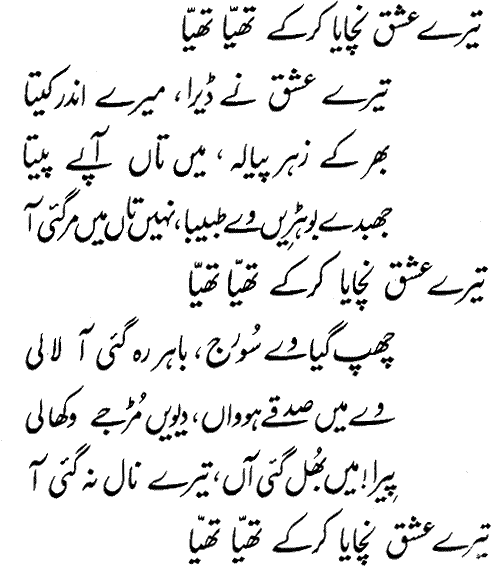
Of all the kalaams in the Qawwali - or rather Sub-continental sufi - canon, no kalam is as easily recognizable as Hz Baba Bulleh Shah (RA)'s immortal Kafi, Tere Ishq Nachaya Kar Thaiyya Thaiyya. It has been performed innumerable times by qawwals, folk musicians, pop singers, playback singers and what not. This paean to love's intoxicating power is probably the most widely performed kalam in the Sufi canon, and as is the wont of Qawwals, each Qawwal of note- or each group of Qawwals - has performed it in their own distinct 'andaz', making the piece their own. Unlike the kalams I've shared in posts of a similar nature, this kalam is unique in that it is part of the Punjabi Sufi canon, therefore it has most expertly been performed by Qawwals that are either from the Punjab or have incorporated the Punjabi sensibility into their performance style. The Punjabi sensibility being an emphasis on takraar, a vigorous 'Taali' and Tabla/Dholak accompaniment and heavy borrowing from the Punjabi sufi canon for girahs etc.

The exact words of the original kalam as written by Hz Baba Bulleh Shah (RA) are slightly modified by each performer, all the while keeping the meanings and the spirit of the original kalam intact. The kalam as written by Hz Bulleh Shah (RA) along with my attempt at a translation is as follows.


Your Love Has Made Me Dance

Your love has made me dance.

Your love has made a place in my heart;
See how I have drained the cup of hemlock
Do not tarry now o Physician !, or I am lost!

Your love has made me dance.


The sun has set, dusk settles on the sky;
My life!, My life for another glimpse of your countenance.
I erred when you called me and I did not follow you.

Your love has made me dance.


Mother, do not deter me from my obsession;
No one can bring back to shore, a boat that has been swept away by the current.
My mind had deserted me when I decided not to go with my beloved.

Your love has made me dance.

A peacock sings in the garden of my love;
I see my Ka'aba, my Qibla in the countenance of my beloved.
The one who wounded my heart and left me, never to look back.

Your love has made me dance.

My Lord finally brought me to Shah Inayat's door;
Who robed me in garments of green and red.
As soon as I began my dance, Lo ! I found my beloved.

Your love has made me dance.


Although the arrangement and composition used by most Qawwals is more or less the same, there are two slightly different arrangements with a slight alteration in the text. One arrangement, which is followed by some Qawwals and the majority of non-Qawwal performers of this kalam, uses the standard 'Tere Ishq Nachaya' - Your love has made me dance , while the other group of Qawwals, mostly those who learned from or were influenced by Fateh Ali-Mubarak Ali Khan Qawwals, use the slightly altered passive-voice opening 'Tere Main Ishq Ne Nachaiyaan' - I have been made to dance by your love. I'm slightly partial to the second arrangement, for its hint of submission to the beloved and because the arrangement imparts a more stately and subdued air to the piece, especially at the beginning. One final word before we begin, this post does not claim to share the best renditions of this kalam, nor the most representative ones; some of these are screechy, others may be too long or too short, the only criteria for inclusion in this post is that of all the versions of this kalam, I love these the best.


The first recording is by Farid Ayaz, Abu Muhammad Qawwal And Brothers. Although their illustrious father, Munshi Raziuddin Ahmed Sb didn't include many Punjabi kalams in his repertoire, concentrating instead on canonical Farsi and Urdu pieces, Farid Ayaz, Abu Muhammad And Bros have incorporated a wide number of influences; Punjabi, Seraiki and Sindhi into their performance style. Their performance of this kalam is spirited, with excellent 'Taali' and backing vocals. One of the standouts of their performance is the brilliant girah that I've heard inserted by this group only;

Yaar de agg'ay sajda karday Mullah dar'day vekhay
Apna yaar manaavan la'iee asaan Sayyad nachday vekhay

We've seen clerics shy from prostrating themselves in front of the Beloved;
We've seen Sayyids dancing before their beloved, hoping for forgiveness.


This verse alludes to the relationship between Hz Baba Bulleh Shah (RA) who was a Sayyid - a descendant of the Prophet (SAW) and his Pir, Hz Shah Inayat Qadri (RA) who was an Ara'ien - a lesser caste that engaged in agriculture and menial occupations. When Hz Bulleh Shah accepted Shah Inayat as his Pir, his Sayyid relations were outraged at the fact that one of the Prophet's descendants was acquiescing to a member of a lowly cast. But Hz Bulleh Shah (RA) paid no heed to the protestations of his peers and devoted himself to the love of his spiritual guide.

Further Punjabi and Urdu girahs, including another one of Hz Baba Bulleh Shah's kafis, further embellish the kalam. The non-native Punjabi accent and the obvious delight the Qawwals take in their presentation add a certain charm to this performance.


The second performance is one of my very favorite performances, not only of this kalam, but of Qawwali as well. It is a -horror of horrors- Filmi Qawwali. Qawwalis in films are generally frowned upon by serious Qawwali afficionadoes because they're either prefab,lipsynched and soulless affairs or those Sawal-Jawab, Male v/s Female qawwali muqablas that are the hallmark of the Bhendi Bazar Bombay school of Qawwali. Yet there are a few exceptions that prove that when done tastefully, Qawwali can have an enormous impact in film. The following performance is one such exception; sung by one of my personal heroes, the singer/actor/filmmaker/poet/politician/scholar Inayat Hussain Bhatti Sb, accompanied by two of the most distinctive voices in Pakistani music, the legendary folksinger Saieen Akhtar and the unbelievably melodious playback singer Munir Hussain . The fact that a single recording combines three of the greatest voices in Pakistan's history would be enough for it to become one of my very favorites, but this recording goes one step further.

From the 1964 Punjabi hit Waris Shah, produced by and starring Inayat Hussain Bhatti Sb as the eponymous Sufi poet, this recording is a bona-fide qawwali. There are two sarangis, there are two main vocalists, there are girahs and takraars, and there is a world of feeling. What I love is that Saieen Akhtar is lipsynching his own voice, so we get to see the intricate hand-movements that he used to do while performing. The arrangement is up-tempo and the sarangis provide wonderful accompaniment. The hallmarks of this performance are the voices of the singers, with their taans and alaaps displaying the range and dexterity they possessed. Bhatti Sb starts the doha with the first verse, Saieen Akhtar supplies the second, and we're off ! My favorite moment in this performance is at the 4:41 mark when Munir Hussain delivers the first verse of a beautiful girah in his wonderfully sweet voice, the second verse of which is supplied by Bhatti Sb. That one verse is the sole contribution of Munir Hussain in this performance, but what a contribution.

Maa Peo kolo'n luk luk rovaan kar kar lakh bahanay
Bulleh Shah je milay pyara, main lakh karaan shukraanay

I cry in secret, hiding my tears from my mother and my father, making thousands of excuses.
O Bulleh Shah, if only my beloved would return, I would spend a thousand years in thankfulness!

This short performance ends with one final girah and a couple of vacillating taans from Bhatti Sb, before winding down to it's conclusion.


The above two recordings were examples of the more commonly used arrangement of this kalam. The remaining recordings share the second arrangement.

Among the many shagirds of Fateh Ali-Mubarak Ali Khan, the foremost was of course Nusrat Fateh Ali Khan. He spent precious few years in the tutelage of his father, with the bulk of his training taking place under his uncle Mubarak Ali Khan; thus his style encompassed the vociferous, spirited delivery of Fateh Ali Khan and the vocal dexterity of Mubarak Ali Khan. Even though he brought many innovations to Qawwali, abandoning older arrangements for new ones, combining girahs and sargams in a unique way, in many instances he preferred the more traditional, classical arrangements of kalams, to spectacular effect. The following recording features Nusrat Fateh Ali Khan and, in my opinion, the best version of his frequently evolving party. Farrukh Fateh Ali Khan is on first harmonium, Mujahid Mubarak Ali Khan is on 2nd vocals, Atta Fareed on 2nd harmonium and Maqsood Hussain on 3rd vocals. A famous quatrain of Hz Baba Bulleh Shah (RA) leads directly to the kalam, and we can see how the slight alteration in the words and arrangement lends a different air to the kalam. All the vocalists share taans and alaaps as the Qawwals incorporate another canonical Qawwali text - Nami Danam Ke Aakhir Choon Dam'e Deedar Mi Raqsam by Hz Usman Harooni (RA) - into the performance. The unique feature here is that Nusrat also includes the beautifully translated Punjabi version of the kalam as well. As the tempo slowly builds and the Qawwals find their groove, launching into mini-takraars, another pretty characteristic feature of Nusrat's performances in England presents itself; drunk uncles dancing and swaying in front of the stage. I've always been very fond of Mujahid Mubarak Ali Khan and have felt that more often than not he gets shortchanged in Nusrat's performances, but here he's participating in full force, engaging in vocal sawal-jawabs with his cousin and using his raspy voice and vociferous hand-movements to great effect. Clocking at over 40 minutes, this performance is a perfect example of how Nusrat managed to stay faithful to the classical idiom yet become such an explosively gifted public performer, how he kept an eye on the requirements of the kalam as well as a finger on the pulse of the audience, and in doing so went down as one of the greatest Qawwals in history.


Note : From here onwards, the recordings get screechier and hissier, you have been warned. If like me, you believe that 'Khazanay tujhe mumkin hai kharaabon main milain', proceed.


The next performance is by another illustrious shagird of Fateh Ali-Mubarak Ali Khan, and one of my personal favorite Qawwali groups,Bakhshi Salamat Qawwal And Party. Bakhshi Khan possessed a voice that was uncannily similar to his ustad Fateh Ali Khan, and in his brother Salamat Ali Khan and fellow vocalist Sadiq Ali "Saddo" Khan, his party had three of the most distinctive voices in Qawwali. I simply love this group. Their recording of this kalam begins with a wonderful flute sazeena, followed by a drop-dead gorgeous quatrain of Hz Khwaja Ghulam Fareed (RA)

Aih dukh yaar Ranjhaitray walay, assan haar wangoon gul paaye
Hik hik dard mahi de utte, sau sukh mol gawa'ey
Jinhaan dardaan vich mera mahi raazi, shala oh dard raihn sawaaye
Ghulam Farida ! Oh dard salamat jinhaan dardaan yaar milaye


All the sorrows that my Ranjha gave me, i've worn around my neck like a necklace
For each one of these sorrows, I've sacrificed thousands of moments of happiness.
If my beloved is gladdened by my sorrows, let them remain with me till eternity;
Ghulam Farid, May God bless these sorrows, for they have brought me close to my Love.

The main kalam is then embellished with taans and zamzamas by Salamat Ali and Saddo Khan, while the flute weaves in and out of the melody. Selections from kafis of Khwaja Ghulam Fareed and Baba Bulleh Shah are used as a girahs. The tempo and the handclaps remain unflagging as the qawwals power through the kalam, creating mini-takraars out of every other verse before finally winding down and ending the kalam at the 13 and a half minute mark.


Another preternaturally gifted shagird of Fateh Ali-Mubarak Ali Qawwal was the late Agha Rasheed Ahmed Fareedi Qawwal. A contemporary of Nusrat, he preferred continuing in the tradition of Khanqahi qawwali over attempting excessive innovations and remained till his death in the late nineteen-eighties, one of the foremost khanqahi qawwals of Pakistan. His primary performance venue was Hz Baba Farid (RA)'s shrine at Pakpattan, where this following performance was recorded. Starting with the voice of Agha Majeed Fareedi and Rasheed Fareedi Sb delivering one of Baba Bulleh Shah (RA)'s most famous kafis, the qawwals linger on the phrase 'mera peer manay', invoking their patron saint, Hz Baba Farid RA with a series of very choice girahs. The main kalam is presented with an arrangement combining the two previously mentioned ones as the tempo builds very slowly and gradually. The qawwals take their time on each verse, creating takraars and then lingering on them till the listeners have had their fill. They also incorporate Hz Usman Harooni (RA)'s kalam and its Punjabi translation; offering protracted takraars on various verses and further girahs on those takraars, as the tempo increases, especially a seven to eight minute takraar on the phrase 'Biya janaan'. These are followed by a series of trademark sargams by Fareedi Sb and his accompanist Mubarak Ali 'Makha' Lahori, which gradually morph into another takraar. These long takrars are a hallmark of Fareedi Sb's performance style, he used these takraars to imperceptibly enhance the state of emotional agitation felt by his listeners to a point where, in his own words" Mera vass challay te aithay saareyaan de kapray paar ke utthaan" - If it were up to me, the audience would leave with their clothes in tatters. Incorporating a kalam made famous by Nusrat - 'Akkhiyaan Udeekdian' and following it with another wonderful sargam,which morphs into another supplication to the saint, the kalam ends just when the tempo can go no higher, bringing a whirlwind performance to a close.

I must mention here that Fareedi Sb's performance style, with its 8 and 10 minute long takraars, might not be to everyone's taste. Also, the pitch in this video is slightly off, making the recording slightly screechy. But I absolutely love it.


The final recording is one that I recently discovered, and I haven't been able to get over it. In fact, this recording prompted me to get busy with this long overdue post. One of the best kept secrets of Qawwali was the Mubarak Ali Niaz Ali Qawwal party. Mubarak Ali had a bullhorn of a voice that had the power to envelop the listener in a sonic stratosphere, he was accompanied by the piercing voice of Niaz Ali who played first harmonium, along with Tufail Khan and Gulloo Khan. Their studio recordings are few and far between but the few that remain are hair-raisingly good. I'm not aware if Mubarak Ali-Niaz Ali were shagirds of Fateh Ali-Mubarak Ali Qawwals, but they follow the arrangement favored by the other shagirds. I could've posted their excellent studio recording of this kalam, in fact I was going to, until I found this one. For one thing, live video recordings of thegroup are very rare, and for another, this is one absolutely kickass performance, which encompasses all the things i love about traditional Punjabi Qawwali. Observe for example the setting; the qawwals are seated on a platform constructed from bricks with a rug thrown over it, the stage isn't large enough to allow all the main performers to sit up front. The venue is open-air, under a shamiaana, with the audience surrounding the qawwals. The performance begins with a beautiful pair of dohas by Hz Khwaja Ghulam Fareed (RA), and the qawwals are off. I'm not going to waste much time on descriptions other than the fact that Mubarak Ali is one of the most animated, one of the most outstanding live performers I've ever seen, that the girahs inserted by the Qawwals, from kalams of baba Bulleh Shah (RA), Hz Baba Farid (RA), Hz Khwaja Ghulam Fareed (RA) and other canonical Punjabi poets, are some of the best I've ever heard (and are in the thaith-est Punjabi, which might make them hard to understand for listeners who don't have more than a passing knowledge of Punjabi). But for those who can understand and appreciate, or who make an effort to understand and appreciate, this recording is an absolute treasure.


N.B :  In choosing a classical Punjabi kalam and focusing on performers who followed the Punjabi ang of Qawwali, I've allowed for the fact that many people might not find these recordings as wonderfully interesting as I do, but like I said at the start, of the dozens of recordings of this kalam, these are the ones I love.