Thursday, July 12, 2012

...Of A Diamond In The Rough

Qawwali has been blessed with many unique voices. Some of them, like Nusrat's, Munshi Raziuddin's or Ghulam Fareed Sabri's,  are justifiably well known. Others, like Murli Qawwal's, Mubarak Ali-Niaz Ali Qawwal's or Rasheed Ahmed Fareedi Qawwal's , are probably not as widely acclaimed as they ought to be. One of the most unique voices in Qawwali was that of Maulvi Ahmed Hassan Akhter Bheranwale Qawwal. Emotive, raspy, mellifluous, with the ability to elicit tons of feeling out of a few notes. He performed mainly in the '70s and 80's with his father - who I'm 90% sure was named Maulvi Akhtar Hassan Qawwal, feel free to correct me if I'm wrong - and his younger brother Maulvi Haider Hassan Qawwal, who currently performs with the remaining members of his elder brother's Qawwali party..

Maulvi Ahmed Hassan quit performing in the late 1980s, which is a real shame because he had a voice and a performance style that was second to none. Performing traditional sufi Kalam in Urdu and Farsi with the same verve and vigour as his Punjabi performances, Maulvi Ahmed Hassan was a true representative of the Punjabi school of Qawwali; imparting a distinctly earthy feel to whatever he sang. The studio recordings he made for OSA are brilliant, with my only gripe being the fact that the recordists didn't place a microphone in front of Maulvi Akhter Hassan, with the result that we can barely hear the senior Qawwal's voice in most of them. Below are some of the recordings of the Maulvi Ahmed Hassan Akhtar Bheranwale Qawwal party that I've managed to accumulate, and they display the group's wonderful command on Urdu/Farsi kalam. The credit for sharing some of these recordings goes to Arif Ali Khan Sb and my dear friend Pedro Ferrari

Main Nazar Se Pi Raha Hoon, Yeh Samaa Badal Na Jaye
A languid mood pervades this very melodious ghazal.


Na Woh Iltefaat-e-Awwal, Na Nigah Main Barhami Hai
A stately start, with a wonderful shift in tempo and some beautiful girahs make this recording stand out.

.

Dikhla Ke Jhalak Tum Chup Hi Gaye
Sounding almost like a Punjabi 'Jhol', this recording features brilliant takraars and girahs.


Aamada Ba Qatle Man
The Qawwals perform Khusrau in this crusty but brilliant mehfil recording, imparting a Punjabi flavor to the Farsi kalam.


Kahoon Kaise Sakhi Ri Mohe Laaj Lage
Another wonderful prelude and a beautifully sustained takraar are the highlights of this PTV performance.

Dil Burd Az Man Di-Roz Shaamay
 Adopting a more measured andaz, the qawwals start off this wonderful Farsi kalam with a beautiful preamble.


Finally, I'd like to share something really special. This is probably among my Top 5 most favorite Qawwali performances ever. If anyone ever wondered whether a Qawwali performance could "swing", this should dispel their doubts. The following performance perfectly encapsulates the Punjabi 'Ang' of Qawwali; a wonderful beat, vigorous taali, taans and alaaps that are imbued with the feel of the land, emphatic yet nuanced singing and a brilliant use of takraar and girah. I have to thank Pedro Ferrari for sharing this video with me and I'm immensely proud to share probably the only complete version of this remarkable performance available on the internet.

Aaja Hun Aaja Arabi Dholna

Some more of Maulvi Ahmed Hassan Bheranwale Qawwal's wonderful performances can be found Here, Here and Here.

Thursday, July 5, 2012

...Of An Absolute Genius

This is an unqualified, unsolicited testimonial.

I think C Ramchandra was one of the greatest composers of Bollywood's golden age.

The inventiveness, freshness, melodiousness and how shall I put it, musicality of his compositions are second to none, and I'm absolutely, wholeheartedly in love with them; especially the ones he composed for Lata Mangeshkar, with whom he was reputed to have had a romantic attachment. Not even Madan Mohan's compositions seem as perfectly tailored for Lata's voice. Unfortunately he's not as well remembered as some of the other great composers of his age like Naushad, Shankar-Jaikishen, OP Nayyar, SD Burman etc. I'd rather let Youtube carry on from here, with some of my most favorite C Ramchandra compositions. Since there are dozens upon dozens of his compositions that I love, I'll limit myself to my ten most favorite ones, plus a bonus .

Katate Hain Dukh Main Yeh Din - Lata Mangeskar - Parchaiyyan 1952
An absolutely stunning composition with beautiful lyrics, sung by Lata in her most lilting voice.


 Shaam Dhale Khirki Tale - Lata Mangeshkar & C Ramchandra - Albela 1951
Geeta Bali is one of my favorite actresses, and Bhagwandada's shuffle-dance is utterly charming.


Woh Hum Se Chup Hain, Hum Un Se Chup Hain - Lata Mangeshkar & C Ramchandra - Sargam 1950
One of the sweetest duets ever, and Raj Kapoor is unbelievably handsome here.


Dil Ki Duniya Basaa Ke Saanwariya - Lata Mangeshkar - Amardeep 1958
That little piano flourish at the beginning of every verse absolutely slays me.


Yeh Zindagi Ussi Ki Hai - Lata Mangeshkar - Anarkali - 1953
C Ramchandra shows his versatility by composing a beautiful, classical-inspired score, ala Naushad.


 Main Jagoon Saari Raien - Lata Mangeshkar - Bahurani - 1963
An almost Madan Mohan like composition, with Lata's voice having matured from the shrillness of the '50s.


 Bholi Soorat Dil Ke Khote - C Ramchandra & Lata Mangeshkar - Albela - 1951
The castanets, the flute intro, the shehnai, the beat on the tambourine, the utterly charming dance steps, this is one of my favorite songs.

 Shola Jo Bharke - Lata Mangeshkar & C Ramchandra - Albela - 1951
Another classic from Albela - I could write a post with just songs from that one film, they're that awesome.

Abhi Shaam Ayegi Niklain Ge Taare - Lata Mangeshkar - Samadhi 1950
I used to have a childhood crush on Nalini Jaywant, it's not hard to figure out why.


Mohabbat Aisi Dharkan Hai - C Ramchandra - Anarkali - 1953
The great composer himself, singing one of his landmark compositions live.

And finally ... I found out very late the C Ramchandra-Lata combo was responsible for one of my dearest and sweetest childhood memories.  

Tuesday, July 3, 2012

...Of The Raqs-e-Bismil, Punjabi Style


It's time for one of those posts again, the ones in which I take one of my favorite pieces from the classical Qawwali canon and share some of my favorite recordings of that kalam. Like I've probably written before, Qawwali is primarily a performer's art, and the standard songbook is open to endless interpretation. The vast Qawwali canon offers each performer ample opportunities to interpret each classical kalam in his own peculiar style, embellishing it with taans and girahs, incorporating other kalaams with similar themes or altering the traditional arrangement to bring out new meanings in the text. This enables each Qawwal to 'own' each kalam and imbue it with some of his own personality, thus making each performance of the same kalam distinct and unique.

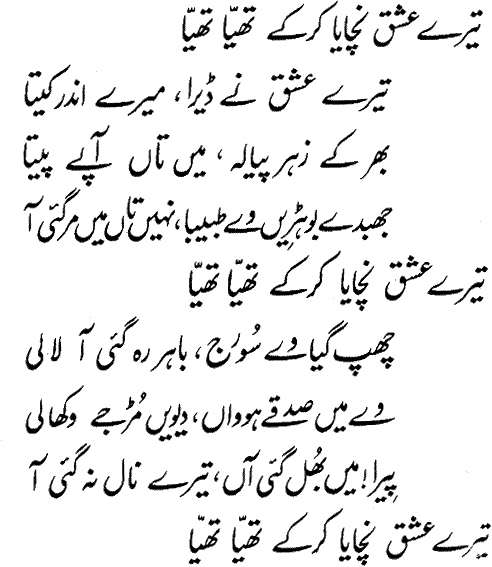
Of all the kalaams in the Qawwali - or rather Sub-continental sufi - canon, no kalam is as easily recognizable as Hz Baba Bulleh Shah (RA)'s immortal Kafi, Tere Ishq Nachaya Kar Thaiyya Thaiyya. It has been performed innumerable times by qawwals, folk musicians, pop singers, playback singers and what not. This paean to love's intoxicating power is probably the most widely performed kalam in the Sufi canon, and as is the wont of Qawwals, each Qawwal of note- or each group of Qawwals - has performed it in their own distinct 'andaz', making the piece their own. Unlike the kalams I've shared in posts of a similar nature, this kalam is unique in that it is part of the Punjabi Sufi canon, therefore it has most expertly been performed by Qawwals that are either from the Punjab or have incorporated the Punjabi sensibility into their performance style. The Punjabi sensibility being an emphasis on takraar, a vigorous 'Taali' and Tabla/Dholak accompaniment and heavy borrowing from the Punjabi sufi canon for girahs etc.

The exact words of the original kalam as written by Hz Baba Bulleh Shah (RA) are slightly modified by each performer, all the while keeping the meanings and the spirit of the original kalam intact. The kalam as written by Hz Bulleh Shah (RA) along with my attempt at a translation is as follows.


Your Love Has Made Me Dance

Your love has made me dance.

Your love has made a place in my heart;
See how I have drained the cup of hemlock
Do not tarry now o Physician !, or I am lost!

Your love has made me dance.


The sun has set, dusk settles on the sky;
My life!, My life for another glimpse of your countenance.
I erred when you called me and I did not follow you.

Your love has made me dance.


Mother, do not deter me from my obsession;
No one can bring back to shore, a boat that has been swept away by the current.
My mind had deserted me when I decided not to go with my beloved.

Your love has made me dance.

A peacock sings in the garden of my love;
I see my Ka'aba, my Qibla in the countenance of my beloved.
The one who wounded my heart and left me, never to look back.

Your love has made me dance.

My Lord finally brought me to Shah Inayat's door;
Who robed me in garments of green and red.
As soon as I began my dance, Lo ! I found my beloved.

Your love has made me dance.


Although the arrangement and composition used by most Qawwals is more or less the same, there are two slightly different arrangements with a slight alteration in the text. One arrangement, which is followed by some Qawwals and the majority of non-Qawwal performers of this kalam, uses the standard 'Tere Ishq Nachaya' - Your love has made me dance , while the other group of Qawwals, mostly those who learned from or were influenced by Fateh Ali-Mubarak Ali Khan Qawwals, use the slightly altered passive-voice opening 'Tere Main Ishq Ne Nachaiyaan' - I have been made to dance by your love. I'm slightly partial to the second arrangement, for its hint of submission to the beloved and because the arrangement imparts a more stately and subdued air to the piece, especially at the beginning. One final word before we begin, this post does not claim to share the best renditions of this kalam, nor the most representative ones; some of these are screechy, others may be too long or too short, the only criteria for inclusion in this post is that of all the versions of this kalam, I love these the best.


The first recording is by Farid Ayaz, Abu Muhammad Qawwal And Brothers. Although their illustrious father, Munshi Raziuddin Ahmed Sb didn't include many Punjabi kalams in his repertoire, concentrating instead on canonical Farsi and Urdu pieces, Farid Ayaz, Abu Muhammad And Bros have incorporated a wide number of influences; Punjabi, Seraiki and Sindhi into their performance style. Their performance of this kalam is spirited, with excellent 'Taali' and backing vocals. One of the standouts of their performance is the brilliant girah that I've heard inserted by this group only;

Yaar de agg'ay sajda karday Mullah dar'day vekhay
Apna yaar manaavan la'iee asaan Sayyad nachday vekhay

We've seen clerics shy from prostrating themselves in front of the Beloved;
We've seen Sayyids dancing before their beloved, hoping for forgiveness.


This verse alludes to the relationship between Hz Baba Bulleh Shah (RA) who was a Sayyid - a descendant of the Prophet (SAW) and his Pir, Hz Shah Inayat Qadri (RA) who was an Ara'ien - a lesser caste that engaged in agriculture and menial occupations. When Hz Bulleh Shah accepted Shah Inayat as his Pir, his Sayyid relations were outraged at the fact that one of the Prophet's descendants was acquiescing to a member of a lowly cast. But Hz Bulleh Shah (RA) paid no heed to the protestations of his peers and devoted himself to the love of his spiritual guide.

Further Punjabi and Urdu girahs, including another one of Hz Baba Bulleh Shah's kafis, further embellish the kalam. The non-native Punjabi accent and the obvious delight the Qawwals take in their presentation add a certain charm to this performance.


The second performance is one of my very favorite performances, not only of this kalam, but of Qawwali as well. It is a -horror of horrors- Filmi Qawwali. Qawwalis in films are generally frowned upon by serious Qawwali afficionadoes because they're either prefab,lipsynched and soulless affairs or those Sawal-Jawab, Male v/s Female qawwali muqablas that are the hallmark of the Bhendi Bazar Bombay school of Qawwali. Yet there are a few exceptions that prove that when done tastefully, Qawwali can have an enormous impact in film. The following performance is one such exception; sung by one of my personal heroes, the singer/actor/filmmaker/poet/politician/scholar Inayat Hussain Bhatti Sb, accompanied by two of the most distinctive voices in Pakistani music, the legendary folksinger Saieen Akhtar and the unbelievably melodious playback singer Munir Hussain . The fact that a single recording combines three of the greatest voices in Pakistan's history would be enough for it to become one of my very favorites, but this recording goes one step further.

From the 1964 Punjabi hit Waris Shah, produced by and starring Inayat Hussain Bhatti Sb as the eponymous Sufi poet, this recording is a bona-fide qawwali. There are two sarangis, there are two main vocalists, there are girahs and takraars, and there is a world of feeling. What I love is that Saieen Akhtar is lipsynching his own voice, so we get to see the intricate hand-movements that he used to do while performing. The arrangement is up-tempo and the sarangis provide wonderful accompaniment. The hallmarks of this performance are the voices of the singers, with their taans and alaaps displaying the range and dexterity they possessed. Bhatti Sb starts the doha with the first verse, Saieen Akhtar supplies the second, and we're off ! My favorite moment in this performance is at the 4:41 mark when Munir Hussain delivers the first verse of a beautiful girah in his wonderfully sweet voice, the second verse of which is supplied by Bhatti Sb. That one verse is the sole contribution of Munir Hussain in this performance, but what a contribution.

Maa Peo kolo'n luk luk rovaan kar kar lakh bahanay
Bulleh Shah je milay pyara, main lakh karaan shukraanay

I cry in secret, hiding my tears from my mother and my father, making thousands of excuses.
O Bulleh Shah, if only my beloved would return, I would spend a thousand years in thankfulness!

This short performance ends with one final girah and a couple of vacillating taans from Bhatti Sb, before winding down to it's conclusion.


The above two recordings were examples of the more commonly used arrangement of this kalam. The remaining recordings share the second arrangement.

Among the many shagirds of Fateh Ali-Mubarak Ali Khan, the foremost was of course Nusrat Fateh Ali Khan. He spent precious few years in the tutelage of his father, with the bulk of his training taking place under his uncle Mubarak Ali Khan; thus his style encompassed the vociferous, spirited delivery of Fateh Ali Khan and the vocal dexterity of Mubarak Ali Khan. Even though he brought many innovations to Qawwali, abandoning older arrangements for new ones, combining girahs and sargams in a unique way, in many instances he preferred the more traditional, classical arrangements of kalams, to spectacular effect. The following recording features Nusrat Fateh Ali Khan and, in my opinion, the best version of his frequently evolving party. Farrukh Fateh Ali Khan is on first harmonium, Mujahid Mubarak Ali Khan is on 2nd vocals, Atta Fareed on 2nd harmonium and Maqsood Hussain on 3rd vocals. A famous quatrain of Hz Baba Bulleh Shah (RA) leads directly to the kalam, and we can see how the slight alteration in the words and arrangement lends a different air to the kalam. All the vocalists share taans and alaaps as the Qawwals incorporate another canonical Qawwali text - Nami Danam Ke Aakhir Choon Dam'e Deedar Mi Raqsam by Hz Usman Harooni (RA) - into the performance. The unique feature here is that Nusrat also includes the beautifully translated Punjabi version of the kalam as well. As the tempo slowly builds and the Qawwals find their groove, launching into mini-takraars, another pretty characteristic feature of Nusrat's performances in England presents itself; drunk uncles dancing and swaying in front of the stage. I've always been very fond of Mujahid Mubarak Ali Khan and have felt that more often than not he gets shortchanged in Nusrat's performances, but here he's participating in full force, engaging in vocal sawal-jawabs with his cousin and using his raspy voice and vociferous hand-movements to great effect. Clocking at over 40 minutes, this performance is a perfect example of how Nusrat managed to stay faithful to the classical idiom yet become such an explosively gifted public performer, how he kept an eye on the requirements of the kalam as well as a finger on the pulse of the audience, and in doing so went down as one of the greatest Qawwals in history.


Note : From here onwards, the recordings get screechier and hissier, you have been warned. If like me, you believe that 'Khazanay tujhe mumkin hai kharaabon main milain', proceed.


The next performance is by another illustrious shagird of Fateh Ali-Mubarak Ali Khan, and one of my personal favorite Qawwali groups,Bakhshi Salamat Qawwal And Party. Bakhshi Khan possessed a voice that was uncannily similar to his ustad Fateh Ali Khan, and in his brother Salamat Ali Khan and fellow vocalist Sadiq Ali "Saddo" Khan, his party had three of the most distinctive voices in Qawwali. I simply love this group. Their recording of this kalam begins with a wonderful flute sazeena, followed by a drop-dead gorgeous quatrain of Hz Khwaja Ghulam Fareed (RA)

Aih dukh yaar Ranjhaitray walay, assan haar wangoon gul paaye
Hik hik dard mahi de utte, sau sukh mol gawa'ey
Jinhaan dardaan vich mera mahi raazi, shala oh dard raihn sawaaye
Ghulam Farida ! Oh dard salamat jinhaan dardaan yaar milaye


All the sorrows that my Ranjha gave me, i've worn around my neck like a necklace
For each one of these sorrows, I've sacrificed thousands of moments of happiness.
If my beloved is gladdened by my sorrows, let them remain with me till eternity;
Ghulam Farid, May God bless these sorrows, for they have brought me close to my Love.

The main kalam is then embellished with taans and zamzamas by Salamat Ali and Saddo Khan, while the flute weaves in and out of the melody. Selections from kafis of Khwaja Ghulam Fareed and Baba Bulleh Shah are used as a girahs. The tempo and the handclaps remain unflagging as the qawwals power through the kalam, creating mini-takraars out of every other verse before finally winding down and ending the kalam at the 13 and a half minute mark.


Another preternaturally gifted shagird of Fateh Ali-Mubarak Ali Qawwal was the late Agha Rasheed Ahmed Fareedi Qawwal. A contemporary of Nusrat, he preferred continuing in the tradition of Khanqahi qawwali over attempting excessive innovations and remained till his death in the late nineteen-eighties, one of the foremost khanqahi qawwals of Pakistan. His primary performance venue was Hz Baba Farid (RA)'s shrine at Pakpattan, where this following performance was recorded. Starting with the voice of Agha Majeed Fareedi and Rasheed Fareedi Sb delivering one of Baba Bulleh Shah (RA)'s most famous kafis, the qawwals linger on the phrase 'mera peer manay', invoking their patron saint, Hz Baba Farid RA with a series of very choice girahs. The main kalam is presented with an arrangement combining the two previously mentioned ones as the tempo builds very slowly and gradually. The qawwals take their time on each verse, creating takraars and then lingering on them till the listeners have had their fill. They also incorporate Hz Usman Harooni (RA)'s kalam and its Punjabi translation; offering protracted takraars on various verses and further girahs on those takraars, as the tempo increases, especially a seven to eight minute takraar on the phrase 'Biya janaan'. These are followed by a series of trademark sargams by Fareedi Sb and his accompanist Mubarak Ali 'Makha' Lahori, which gradually morph into another takraar. These long takrars are a hallmark of Fareedi Sb's performance style, he used these takraars to imperceptibly enhance the state of emotional agitation felt by his listeners to a point where, in his own words" Mera vass challay te aithay saareyaan de kapray paar ke utthaan" - If it were up to me, the audience would leave with their clothes in tatters. Incorporating a kalam made famous by Nusrat - 'Akkhiyaan Udeekdian' and following it with another wonderful sargam,which morphs into another supplication to the saint, the kalam ends just when the tempo can go no higher, bringing a whirlwind performance to a close.

I must mention here that Fareedi Sb's performance style, with its 8 and 10 minute long takraars, might not be to everyone's taste. Also, the pitch in this video is slightly off, making the recording slightly screechy. But I absolutely love it.


The final recording is one that I recently discovered, and I haven't been able to get over it. In fact, this recording prompted me to get busy with this long overdue post. One of the best kept secrets of Qawwali was the Mubarak Ali Niaz Ali Qawwal party. Mubarak Ali had a bullhorn of a voice that had the power to envelop the listener in a sonic stratosphere, he was accompanied by the piercing voice of Niaz Ali who played first harmonium, along with Tufail Khan and Gulloo Khan. Their studio recordings are few and far between but the few that remain are hair-raisingly good. I'm not aware if Mubarak Ali-Niaz Ali were shagirds of Fateh Ali-Mubarak Ali Qawwals, but they follow the arrangement favored by the other shagirds. I could've posted their excellent studio recording of this kalam, in fact I was going to, until I found this one. For one thing, live video recordings of thegroup are very rare, and for another, this is one absolutely kickass performance, which encompasses all the things i love about traditional Punjabi Qawwali. Observe for example the setting; the qawwals are seated on a platform constructed from bricks with a rug thrown over it, the stage isn't large enough to allow all the main performers to sit up front. The venue is open-air, under a shamiaana, with the audience surrounding the qawwals. The performance begins with a beautiful pair of dohas by Hz Khwaja Ghulam Fareed (RA), and the qawwals are off. I'm not going to waste much time on descriptions other than the fact that Mubarak Ali is one of the most animated, one of the most outstanding live performers I've ever seen, that the girahs inserted by the Qawwals, from kalams of baba Bulleh Shah (RA), Hz Baba Farid (RA), Hz Khwaja Ghulam Fareed (RA) and other canonical Punjabi poets, are some of the best I've ever heard (and are in the thaith-est Punjabi, which might make them hard to understand for listeners who don't have more than a passing knowledge of Punjabi). But for those who can understand and appreciate, or who make an effort to understand and appreciate, this recording is an absolute treasure.


N.B :  In choosing a classical Punjabi kalam and focusing on performers who followed the Punjabi ang of Qawwali, I've allowed for the fact that many people might not find these recordings as wonderfully interesting as I do, but like I said at the start, of the dozens of recordings of this kalam, these are the ones I love.

Friday, May 25, 2012

...Of Slow Suffocation


You know how when you're beginning to have an asthma attack ( I'm assuming for argument's sake that the gentle reader is like me, an asthmatic) and you suddenly realize that this breathing lark isn't as easy as everyone makes it out to be. There's a specific moment when something tells you that the simple act of breathing in and out is going to turn into an ordeal very soon. The attack begins with a rather melodious bout of wheezing, much like a fanfare announcing the arrival of the royal entourage in a historical epic.Your initial reaction is to tell yourself, "Oh boy, here we go again. Well, let's start by remaining perfectly calm shall we. We've handled stuff like this before, all we've got to do is keep breathing like we've practiced and it'll all be over before we know it" (Notice how the gentle reader uses the royal "we", pretty conceited chap isn't he). The initial self-imposed calm is short lived though, as the wheezing gives way to a weird dragging sensation in the lower chest and breathing begins to require effort. You look around for the trusty inhaler as you try to keep your rapidly increasing heartbeat in check, but very soon you realize that the inhaler was emptied and thrown out weeks ago.

That's when the attack enters its next and more serious phase, the stage where you have to sit up in your chair, place your hands on your knees and actually exercise your respiratory muscles so that you can receive oxygen. You wordlessly star chanting "I'm going to be OK, I'm going to be OK" to yourself as your head starts to spin, your heart beats loud enough to wake the people in the next room and a sudden thought fills your mind with dread,"What if this is it, the big one?". Luckily, that's about as far I've gown down the asthmatic route, stopping just short of the final, more sinister stage of an attack. That's when the instinct for self-preservation that has been coaxing the sufferer to try and keep breathing in and out in the hope of a let-off in hostilities is gradually overpowered by the deadly trio of muscle fatigue, a lack of oxygen and the deliciously narcotic effects of the carbon-dioxide flooding the brain. This dastardly trio gently distracts the brain, telling it "Why do you keep punishing yourself by taking these painful, pitiful breaths? Hasn't anyone told you, breathing's overrated. Why don't you let us take over and have a nice little lie-down? Don't worry, you won't feel a thing". The patient, who has pretty much given up at this point, waves away the final appeals of the ol' self-preservation instinct, puts his trust in the soothing thoughts filling his mind, and floating on a neurochemical high, hands in his dinner-pail.

The fact that I'm writing this is proof enough that I haven't reached the final, deadly stage yet. But I'm afraid that's more or less where I'm headed. Except for the difficult breathing bit, the palpitations and panic bit, the Carbon-dioxide high bit and the general dying from asthma bit. Let me explain.


A year ago, when I got posted to the jungle, a menagerie of horrors awaited me there. Does the gentle reader (provided he's still alive) dare to hazard a guess as to what was the most horrific attraction of this house of horrors? It wasn't the rather diverse, multiethnic and peacefully coexisting population of jackals, wild boar, porcupines, mongoose and lizards; it wasn't the unbearable heat or the stranglingly suffocating humidity, it wasn't the snakes who seemed to act like they owned the place (which let's face it, they did); it wasn't the fact that luxuries like electricity and running water were considered something that hadn't been invented yet and muslim showers were things you heard about in the fantastical stories told by travelers from faraway lands; it wasn't the leaky roof that ensured that a trivial thing like being indoors didn't get in the way of one's enjoyment of the weather; it wasn't the three mile distance between my room and the nearest human habitation, which meant that a simple task like having dinner involved jeep-rides over ill-maintained dirt tracks in the pouring rain; it wasn't the divers wasps and scorpions and mosquitoes and the unknown little insects that managed to send me into the ER at four in the morning with a severe allergic reaction and an unrecordably low blood pressure; it wasn't the weird composition of the water that miraculously accelerated my journey towards possessing a shiny bald pate before my twenty-sixth birthday.

The absolute cherry on the icing on the triple-layer of frosting on the cake was the fact that I had stepped into a communications black-hole.

No cellphone signals. Of any kind. No internet (obviously). No mailing address in case anyone, desperate to get in touch with me (the probability is very low, I know) would want to resort to snail mail. A very shoddy land-line and a complete absence of carrier pigeons. These conditions would have driven any normal person to distraction. For something like this to happen to me; someone who had won the Inter-district speed-texting championship for three years running, who had been kicked out of funerals for snickering at a text message, who had worn off the keys of one cellphone and had bought a rather expensive new one just weeks before being shipped off to Godforsakenland, who had made a career out of texting to the extent that keen-eyed readers would read friends of mine's  texts and say,"Hmm, this text carries shades of Neo-Expressionism mixed with a hint of Musab-ism". Like I was saying, for something like this to happen to me was the greatest irony of fate since Beethoven lost his hearing.

And this is where the rather shabbily assembled asthma analogy begins to emerge from the shadows and clears its throat as if to say, " What with the comparisons between the death of a person from a a horribly debilitating medical condition and being sent to a place where you can't text, I must admit I'm a rather flimsy analogy, but at least hear me out for a second".

When I had landed in the jungle and had taken stock of my situation, quickly tabulating the various drawbacks and annoyances and coming to the conclusion that staying in a communications black hole would be injurious to health, I calmly began devising ways of dealing with the situation. The first step was the most basic, an innate reflex found so commonly in sufferers of my malady that it seems to have been hard-wired into human brains as an instinct necessary for survival - wandering around the jungle with the cellphone held above my head, looking for signals. I was quickly rewarded with what ultimately turned out to be a deceptive sign of improvement. there were microscopic spots in the jungle where the heavens aligned just enough and the matter-antimatter interactions were occurring at just the right velocity to allow some cellphone signals to penetrate the black hole. This initial success was quickly negated when I realized that the signal hotspot was the regular meeting-place of the local serpentine population. A couple of near-brushes with my legless, slithery neighbors were enough to drive me back indoors.

Then began a desperate, rather pointless and in retrospect, quite pitiful search for solutions to the communications problem. A landline connection ? the exchange was too far away. Satellite internet ? The cost would be higher than the GDP of Sub-Saharan Africa. Cellphone antennas ? Excellent at attracting lightning, not so much when it came to signals. Carrier pigeons ? A cursory census of the birds of prey flying above my room quickly put that idea to rest. I had to admit I was licked, for the moment at least.

Then came the brief but mild improvement that lulled me into thinking that maybe I was going to survive after all. I managed to procure a clunky old phone-like contraption from somewhere that somewhat restored my contact with the outside world. If the weather was just right and the earth's magnetic axis was perfectly aligned and the sprites and elves of the jungle were feeling particularly benevolent, I could catch a few signals and maybe call home once every few weeks. In addition, I was also able to access something faintly resembling the internet for a few minutes every day, but only I limited myself to opening the picture-less, flash video-less mobile versions of most websites. Still, something was better than nothing, or so I thought.

Pay attention gentle reader, for this is where the asthma analogy finally emerges from its cocoon, revealing itself to be a supersonic jet powered butterfly. With lasers. Just as I thought I was finally recovering from this communications funk, out popped a ferocious lightning storm and fried every electrical contraption in my room, including my phone. In a single flash, my endeavors were nullified. By this time, the beginning of the summer and all its accoutrements - snakes and insects and the lot - coupled with my increasing frustration with my attempts to establish communication, had begun to take their toll. Where once I had bothered the hell out of friends and relatives with barrages of texts and calls, I was now in contact with only my immediate family and one or two very close friends. The regular blogging and Facebook trawling was replaced with hour-long waits for the darned webpage to open, followed by hours more before it would display properly. The  rather tenuous bridges to what was an essential social support structure were getting harder and harder to maintain. And then lightning struck, literally.

Not ready to give up just yet, I gave it one final try, setting up a new phone to replace the fried one. The result is that I'm now in the third, premorbid stage of communications deficiency. I can call home, but I have to endure fleeting signals, long periods of radio silence and frequent disconnections; to the point where it's become something of a chore to even call home. The dozens of other people, friends and relatives, have slowly and gradually depleted in number to just the one or two, for the same reasons. I'm beginning to think if this staying in touch lark is actually all that it's made out to be. If the parties of the second part were eager to communicate, they'd call themselves. And besides, who needs friends anyway, I'd much rather just curl up and spend the entire day in a semi-catatonic state. All the blogs I used to read and Qawwali recordings I used to share and the videos I used to convert into MP3s, slowly they're beginning to feel less and less worth the effort. After all, why can't I listen to my own music and watch my movies and read my books without rushing off to the internet to blabber about them to the rest of the world. I'm sure someone else will do it much better than me. I'll just listen to this 45 minute recording of Qawwal Bahauddin Khan myself and forget about sharing it with anyone else.

One by one, these long ingrained habits are getting harder and harder and lesser and lesser worth my while to keep up. The numbing effects of being incommunicado are gradually beginning to take over and I'm afraid that unlike my old friend Asthma, I might not be able to resist for long the rather tempting overtures of what appears to be a rather unsplendid isolation.

Friday, April 20, 2012

...On Levon Helm's Passing

Levon Helm passed away last night, a day after his family had posted that he was in the last stages of his long and heroic battle with throat cancer. Even though this was a long time coming, the slow inevitability of it doesn't lessen the sadness one bit.

I'm not in the mood for writing another obituary, Steven Hayden over at the AV club and Charles P. Pierce at Esquire have written quite beautiful and heartfelt ones that perfectly encapsulate how I felt about one of my favorite musicians and one of the coolest cats ever to grace this planet; and I've already inundated my Facebook with dozens of links and videos and so forth in what has  become the 21st Century's go-to grieving ritual.

After Clarence Clemons' passing earlier this year and now Levon's, I think someone must send out a team of doctors to check up on Dylan, Cohen, Neil Young, Tom Waits, the Boss and the rest of my musical heroes and give them all clean bills of health. I'll readily volunteer my services for such an endeavor.

Anyway, Rest in Peace Levon, and thanks for all the years of great music.